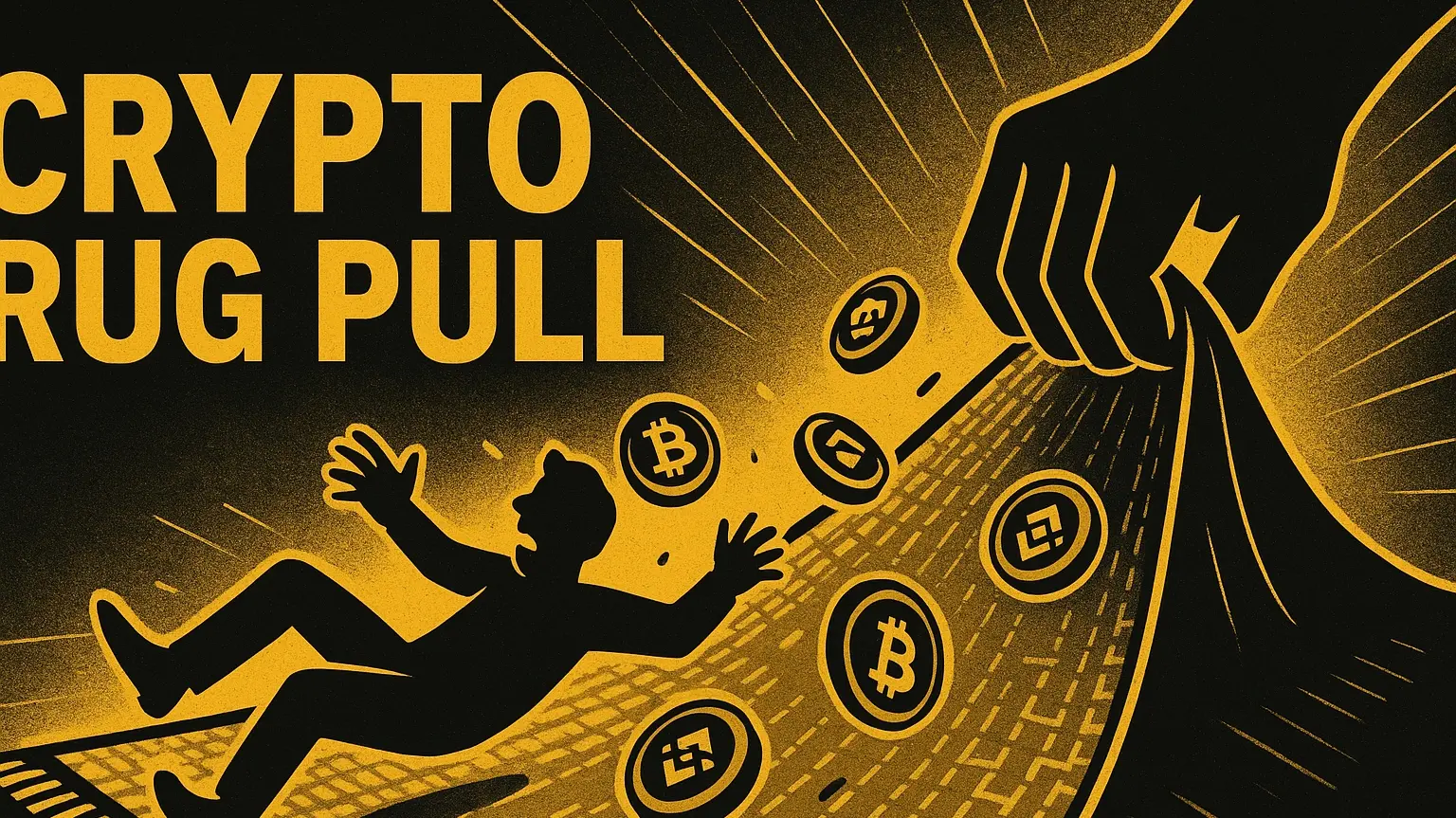
How to Spot a Rug Pull Before You Lose Your Money
Rug Pull: A Short Definition
A rug pull is a scam in which a project's creators abruptly drain all liquidity or dump their own token holdings, crashing the price and leaving investors with nothing: more in our glossary.
Why It's Still a Massive Problem
Rug pulls remain the most expensive type of fraud in retail crypto: according to CoinLaw, investors lost roughly $500 million to them in 2025 alone, with the average amount stolen per scheme rising to around $510,000. Anonymous developers are behind nearly all of them — in 92% of 2025 cases, the creators' identity was never confirmed, and up to 60% of new meme coins get flagged as likely rug pulls within their first 30 days.
7 Warning Signs You're Looking at a Future Rug Pull
- An unverified or unaudited smart contract — hiding the code lets a developer quietly add emergency minting, pausing, or wallet-blacklisting functions.
- Liquidity that isn't locked, or is locked for under 30 days — meaning the developer can technically pull it at any moment.
- Top 10 holders controlling more than 40% of supply — a handful of wallets can orchestrate a mass sell-off on their own.
- A honeypot: the contract allows buying but blocks or heavily taxes selling, so you physically can't exit the position.
- Suspiciously uniform trading volume — identical trade sizes with perfect timing usually signal artificial volume, not organic interest.
- Synchronized promotion from multiple influencers at once — it manufactures the appearance of organic hype right before a dump.
- An anonymous team with no verifiable track record — if the creators can't be found, they have nothing reputational to lose, notes DEXTools' checklist.
Squid Game Token: A Textbook Example
In October 2021, the Squid Game (SQUID) meme coin, named after the hit TV show, surged more than 23,000,000% in a week, peaking at $2,861 per token on November 1, 2021. A hidden function in the contract blocked almost all holders from selling. That same day, the developers drained roughly $3.38 million in liquidity and vanished along with the project's website — the price collapsed to zero within minutes, Wikipedia records.
What to Do When You're Not Sure
Check the contract code through a block explorer and look up its audit status, verify the liquidity lock through a locking service, and before a large purchase, sell a small test amount first — if the sell fails or gets taxed at an extreme rate, that's a honeypot. Social media hype alone, without these checks, isn't a good enough reason to put money in.
Nothing here should be taken as financial advice — just information to consider.

Comments (0)
No comments yet — be the first!
Related articles

What Is AML and How Exchanges Vet Their Users
Why does an exchange suddenly ask you to prove where your funds came from? Here's what AML actually is, why the Travel Rule exists, and how user screening works in practice.
Gemini and Google DeepMind: The Full Story
From Bard's disastrous debut, which wiped $100 billion off Alphabet's market cap, to 900 million monthly users — here's the full history of Gemini and Google DeepMind: products, growth, controversies, and lawsuits.
How to Trade P2P Safely: A Step-by-Step Guide
P2P trading is growing worldwide — and it's also where scams happen most often. Here's how escrow protects you and what to check before you release funds.