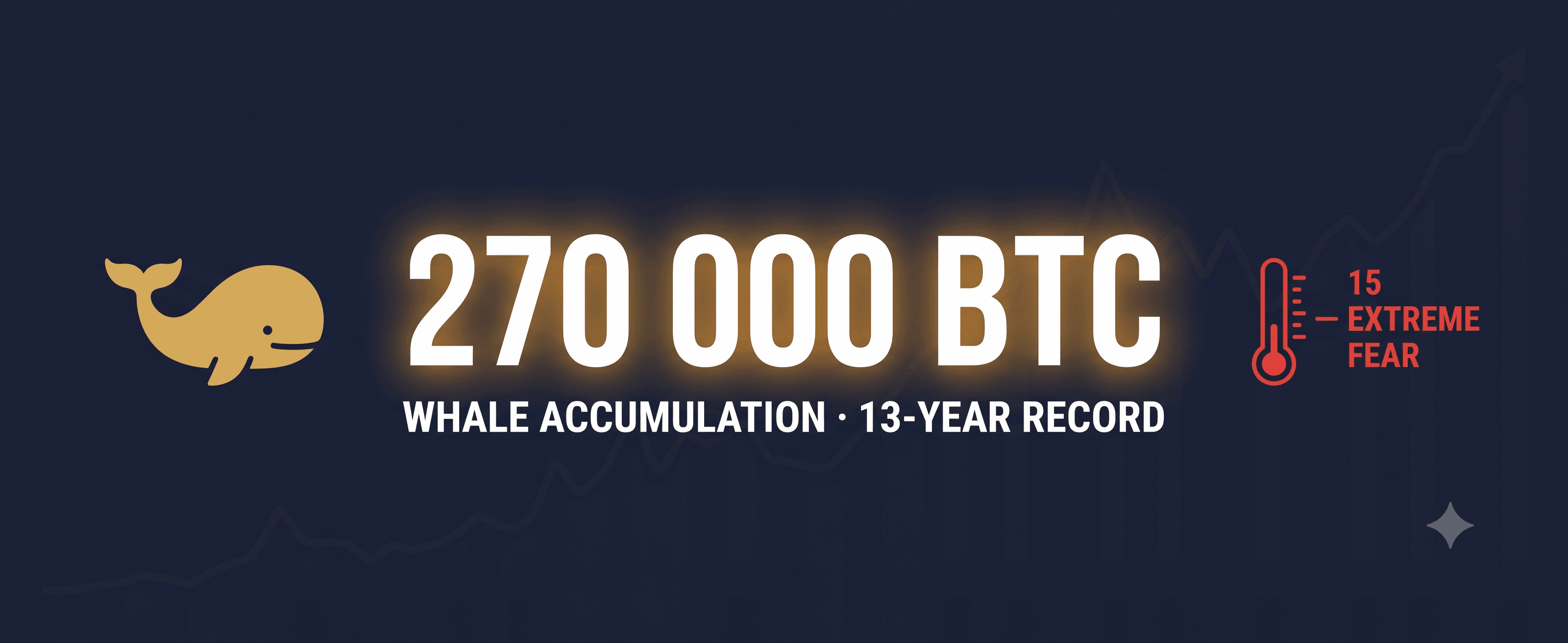
Whales Bought 270,000 BTC: Largest Accumulation in 13 Years as Market Panics
While retail investors are locking in losses and the Fear & Greed index falls to 15 (Extreme Fear), large wallets are moving in the opposite direction. On-chain analytics have recorded a new benchmark: addresses holding over 1,000 BTC accumulated 270,000 Bitcoin in 30 days — the largest monthly accumulation since 2013, BGeometrics reports.
What on-chain says: three key metrics
According to CryptoQuant, the Exchange Whale Ratio — the share of large deposits in total exchange inflows — reached 0.64. That is the highest level since October 2015, an 11-year extreme. While rising whale deposits can signal selling pressure, analysts in this context interpret the reading as position restructuring rather than distribution, CoinMarketCap/CryptoQuant.
The second signal: Whale Accumulation Trend Score stands at 0.68 on a 0–1 scale. Readings above 0.6 historically correspond to structural, not speculative, accumulation phases. Third: 2,140 addresses with balances above 1,000 BTC expanded their positions over the past month.
Context: the market at peak fear
Bitcoin is consolidating in the $58,000–$60,000 range — a 21-month low. Sentiment is crushed: the Fear & Greed index at 15 (Extreme Fear), spot Bitcoin ETFs recording multi-billion outflows. It is precisely under these conditions that the divergence between large and small holders reaches its widest point, AMBCrypto notes.
The average spot order size on Binance exceeds $1.9 million — a sign of professional, not retail, volume. The contrarian logic is straightforward: smart money buys an asset when the majority fears it.
Precedents: what followed similar accumulation phases
"Largest monthly accumulation since 2013" — BGeometrics assessment based on on-chain data across the 1,000+ BTC wallet cohort.
Similar accumulation patterns were recorded at end-2018 (BTC near $3,200), summer 2022 (BTC near $17,000) and March 2020 (BTC near $4,000–5,000). In all three cases, a peak in accumulation was followed by a multiple-digit recovery — with a lag of 3 to 8 months. The current situation does not guarantee a repeat of that scenario, but on-chain data warrants close attention.
This article is for informational purposes only and does not constitute investment advice. Past patterns do not guarantee future results.
Comments (0)
No comments yet — be the first!
Related news
SEC Opens ETF Rule Review: Crypto Products to Receive Tech-Neutral Treatment

57,000 Jobs Instead of 115,000: Weak US Data Pushed Bitcoin to $62,000
