
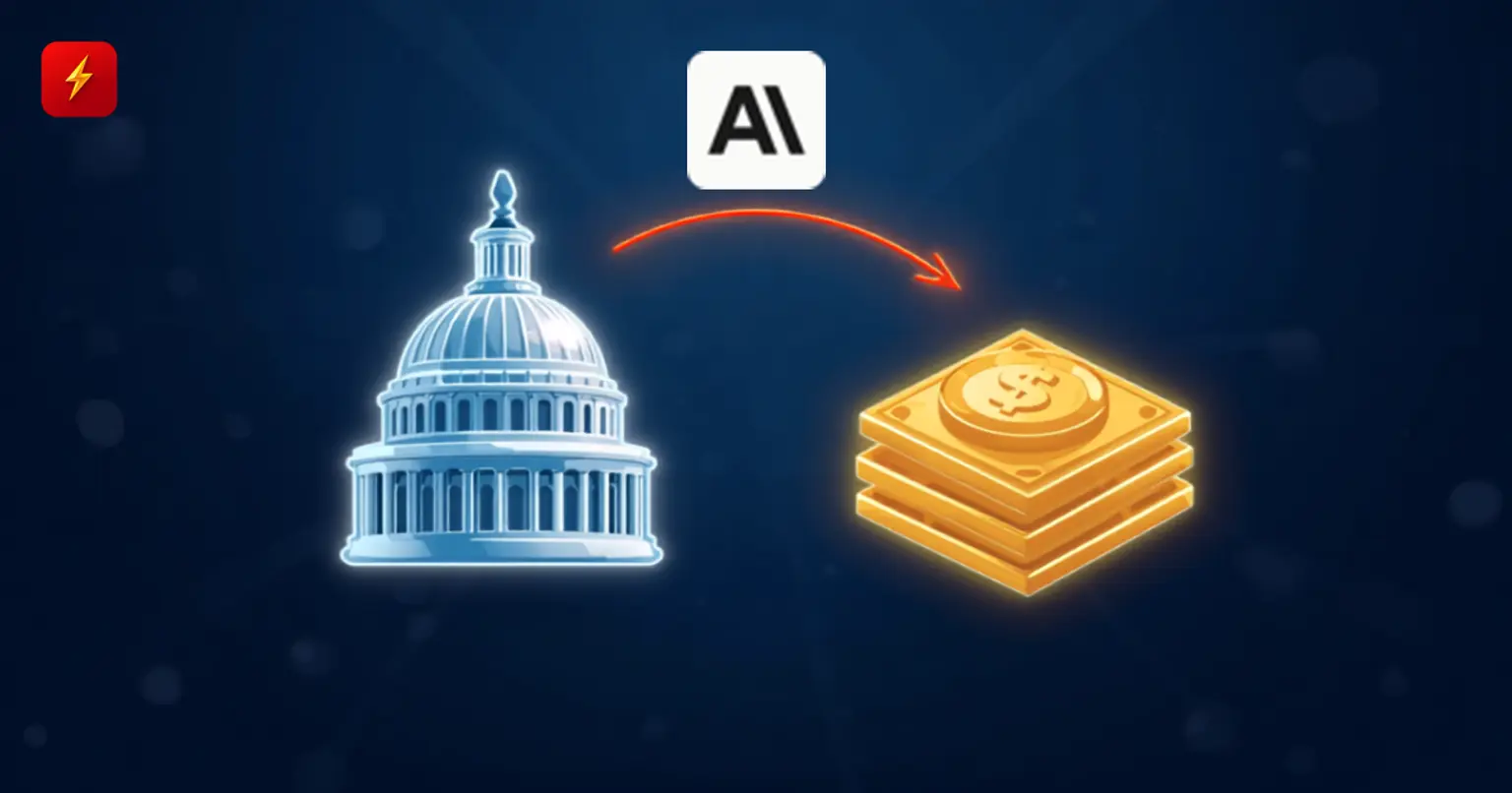
Anthropic now outspends OpenAI on Washington lobbying

A company that built its reputation on being careful about AI is, in Washington, behaving exactly like every big corporation before it: paying lobbyists to shape the rules before they're written without its input. Anthropic spent $3.53 million on federal lobbying in the first half of 2026 — nearly triple its pace a year earlier, and $1.3 million more than rival OpenAI's $2.22 million, according to the Financial Times.
Who spent what
The quarterly breakdown shows the growth isn't slowing down: Anthropic spent $1.97 million in Q2, up 26% from Q1 and its highest quarterly total since it started lobbying back in March 2024. OpenAI shows a similar pattern: $1.2 million in Q2, up 18%. Combined, Anthropic's first-half 2026 spending already exceeds its entire 2025 lobbying budget of $3.1 million, BeInCrypto reports, citing the FT.
Where the money goes
The list of topics reads like an agenda for the whole industry: export controls, cybersecurity, AI safety standards, copyright, cloud computing regulation, and defense procurement. Company lobbyists met with lawmakers in both chambers of Congress, plus officials at the White House and the Commerce Department — and, notably, the Treasury Department, which Anthropic lobbied for the first time this quarter.
Export controls aren't an abstract line item here: earlier this month we covered how Anthropic's Fable 5 and Mythos 5 models spent 19 days under an export ban before the restrictions were lifted — the US has lifted export controls on Fable 5 and Mythos 5. A company whose regulatory exposure can freeze a product launch for weeks has a direct financial incentive to keep a standing presence in Washington rather than react after the fact.
Opposite bets: Anthropic backs state AI laws, OpenAI fights them
Here's where it gets more interesting than "both companies pay lobbyists" — they're lobbying for close to opposite outcomes. Anthropic publicly endorsed California's SB 53, which requires developers of frontier models to publish risk-management plans, undergo independent evaluation, and report critical incidents within 15 days — or 24 hours if public safety is at risk. OpenAI and Google haven't directly opposed the law, but they've pushed hard for federal preemption — a single national standard that would override the patchwork of state rules, Brookings explains.
Anthropic's logic is straightforward: the company already largely complies with SB 53 through its own Responsible Scaling Policy, so tougher state laws reinforce its "safety-first" brand rather than undercut it. OpenAI's product footprint is broader and its regulatory surface bigger — one federal rulebook is cheaper to comply with than fifty different state versions.
Still small change next to Big Tech
Against the industry's heavyweights, both AI startups still look modest: the five biggest tech spenders — Meta, Amazon, Google, Microsoft, and Nvidia — spent a combined $21.25 million on lobbying in Q2, nearly seven times what Anthropic and OpenAI spent together. But on growth rate, the AI companies stand out: Anthropic has already overtaken Nvidia's lobbying spend and is closing in on Oracle's $2 million, while OpenAI sits just below Nvidia's $1.25 million, Yahoo Finance notes.
Why now
The AI industry is under growing scrutiny in Washington, with proposals ranging from voluntary model certification to the government taking equity stakes in AI companies. The President has already signed an order requiring a voluntary 30-day government review of models before launch — exactly the kind of rule that could directly delay future Claude releases. Combined, Anthropic and OpenAI's lobbying spending has roughly doubled year over year, Issue One calculates.
Here's what that actually changes: an industry that until recently sold itself as fundamentally new, playing by different rules, is behaving in Washington in a thoroughly old-fashioned way — hiring the same lobbyists, walking the same hallways as pharmaceutical and defense companies before it. The only real difference is speed: Anthropic went from barely registering in Washington to lobbying the Treasury Department in a little over two years.
The open question for the rest of the year isn't whether this growth slows down — it's what it turns into: a defensive presence against other people's bills, or a tool for writing its own.
This article is for informational purposes only and does not constitute investment advice.

Author
Maks RybalkoReviewer
For the past four to five years, I've been actively interested in the cryptocurrency market, using a variety of tools: trading bots, trading, and long-term investing. I share my personal observations in my articles.
Comments (0)
No comments yet — be the first!
Related articles

$661B and a 62x upside: what's behind crypto's rough June
In June, crypto's market cap fell 16.9% and bitcoin dropped 20.5%. But real-world asset (RWA) tokenization kept growing through the correction — and according to Binance Research, could expand 62x. Here's what the monthly report actually shows.
Wispr Flow and AI Voice Typing Services: 2026 Comparison
AI voice typing services — Wispr Flow, Superwhisper, Willow Voice, Aqua Voice and more: how they work, what they cost, how they differ, and which one actually fits your workflow.

Real-world asset tokenization grew 5x in a year — and is aiming for $19 trillion by 2033
The market for tokenized real-world assets — bonds, real estate, private credit — has hit $31 billion on-chain, growing nearly 5x in a year. Here's who's already making money on it, and why analysts are talking trillions down the road.
Most read
Silicon Valley Workers Are Wearing Noise-Cancelling Masks to Dictate AI Prompts
205 views
Elon Musk Expands Access to X Money, the Payments Service Inside X
153 views
Strategy Didn't Buy Any Bitcoin Last Week — and Now Has a Plan to Sell It
45 views
Layer-2: How Blockchains Get Faster Without Touching the Base Chain
44 views
Silicon Valley's weird AI-dictation mask trend is the tip of a $22 billion voice AI boom
32 views
Crypto Cards That Never Take Your Keys
32 views
Crypto Market Drops 4-5% in a Day: What Volume and Traders Are Saying
31 views