ChatGPT vs Claude vs Gemini vs Grok vs Perplexity: Comparing 2026's Top 5 AI Services
Open any of these five services and you'll see the same thing: a text box for your question and a window for the answer. That makes ChatGPT, Claude, Gemini, Grok, and Perplexity look like the same product wearing five different logos. In reality, each one is built by a company with its own idea of what AI is even supposed to do — and that matters far more for picking one than any abstract "which is smarter" debate.
Why these five are worth comparing at all
Before comparing prices and features, it helps to understand the core split: these five services aren't solving the same problem. OpenAI is building the widest possible everyday tool. Anthropic bets on safety and on text/code work. Google is folding AI into services you already use every day. xAI sells speed and access to live data with fewer guardrails on its answers. And Perplexity isn't really a "conversation partner" at all — it's a search engine that answers with sources. Here's each one, in order.
ChatGPT (OpenAI) — the most recognizable, the widest toolset
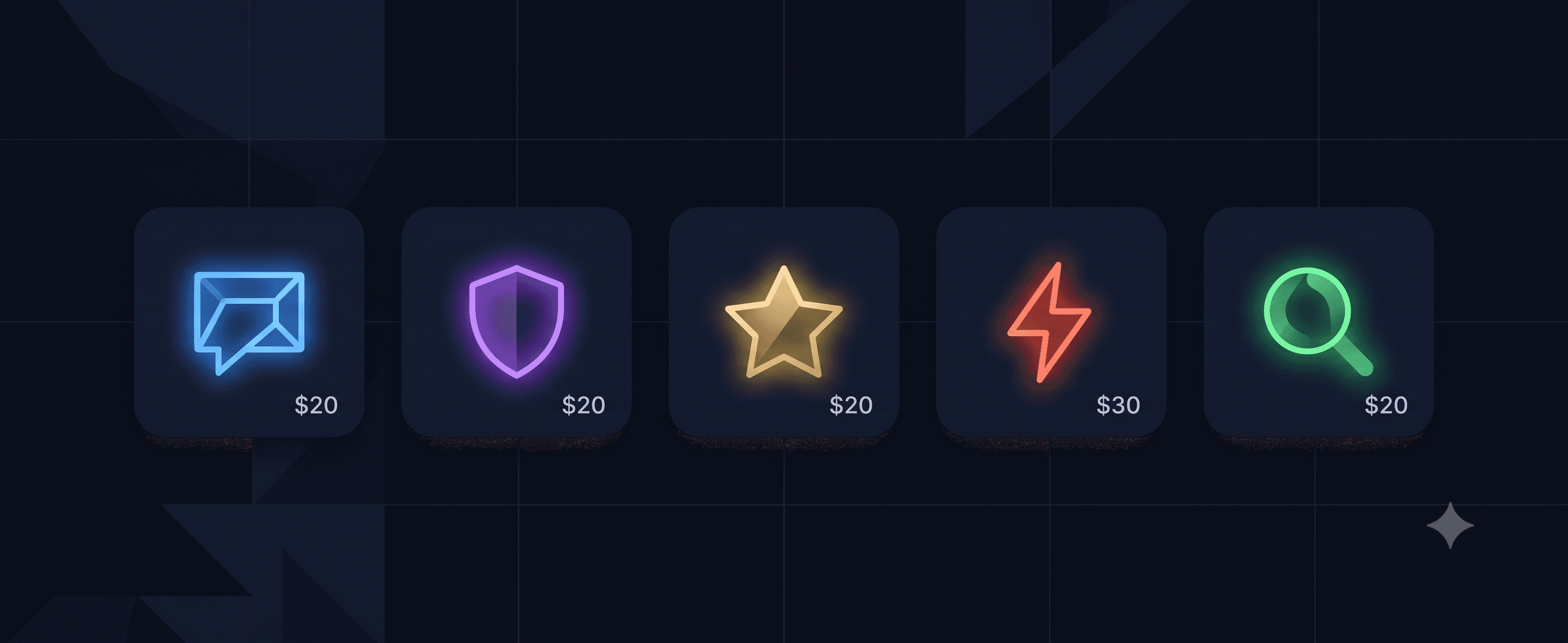
ChatGPT runs six tiers: Free (GPT-5.3, capped at 10 messages every 5 hours), Go at $8/month, Plus at $20/month, Pro at $200/month, Business starting at $20/user, and Enterprise at custom pricing (150-user minimum), per the official pricing page. Plus at $20 is usually called the sweet spot: the full model lineup, the Sora video generator, the Codex coding assistant, Agent Mode, and Deep Research (10 runs a month). Pro at $200 removes nearly every limit and adds priority access to the most powerful models.
Who it's built for: anyone who wants one tool for everything — text, code, images, video. ChatGPT has the widest audience and the broadest built-in toolkit of all five services. The company itself, by the way, is currently gearing up for an IPO — we covered how Coinbase already launched futures letting traders get exposure to its shares before the official listing.
Claude (Anthropic) — betting on safety and serious text work
Claude runs four main tiers: Free, Pro at $20/month, Max at $100/month ("5x" limits) or $200/month ("20x" limits), plus Team and Enterprise, according to the official pricing page. Pro defaults to the Sonnet model with limited access to the more powerful Opus, plus Research mode, unlimited Projects, Microsoft 365 integration, and voice mode. The Max tiers add a separate weekly Opus allowance and access to Claude Code, a dedicated coding assistant.
Anthropic has emphasized AI safety as its core differentiator since its founding in 2021 — that's a genuine positioning choice, not just marketing copy. Who Claude is built for: people who spend a lot of time on text, documents, and code, and who prefer a more careful, measured tone in responses.
Gemini (Google) — the most "built-in" option
Gemini runs four tiers: Free, Google AI Plus at $4.99/month, Google AI Pro at $19.99/month (the main set of advanced features), and Google AI Ultra at $99.99/month (5x Pro's usage limits) or $200/month (20x the limits), according to Google's official subscriptions page. The Ultra tiers add Gemini Spark, a background AI agent that can carry out tasks across Google's own services, the Deep Think reasoning mode, the Nano Banana 2 image generator, plus 20TB of cloud storage and a bundled YouTube Premium subscription.
At Google I/O 2026, CEO Sundar Pichai described the company's AI goal this way: to make its products "radically more helpful, for everyone everywhere," he said. Who Gemini is built for: people already living inside Google's ecosystem — Gmail, Docs, YouTube — who want AI folded into services they already use, not a separate app.
Grok (xAI) — betting on speed and "unfiltered" answers
Grok has the messiest pricing grid of the five: a free tier running a stripped-down Grok 4 Mini model (roughly 10 prompts every two hours), X Premium at $8/month (Grok access bundled inside the X app), SuperGrok Lite at $10/month, full SuperGrok at $30/month, X Premium+ at $40/month, and SuperGrok Heavy at $300/month — the single most expensive tier among all five services, per the official xAI pricing page. SuperGrok at $30 gives full access to the Grok 4 model, the DeepSearch research mode, Big Brain extended reasoning, unlimited Grok Imagine image generation, and real-time access to data from X.
Elon Musk sums up xAI's philosophy in one line: "Maximally truth-seeking is absolutely essential to ensuring a good AI future for humanity," he wrote. In practice, that translates to more direct, less heavily moderated answers than competitors. Who Grok is built for: active X users who want live access to what's happening on the platform and prefer a less cautious tone in responses.
Perplexity — not a chatbot, an AI search engine
Perplexity is built differently from the other four: a free tier, Pro at $20/month, Max at $200/month, plus Enterprise Pro at $40 and Enterprise Max at $325 per seat per month, its official pricing page notes. Pro adds extended search limits, access to top-tier models like GPT-5 and Claude Opus 4.6, image and video generation, and the Comet browser agent. Max is the most distinctive tier: it includes Model Council, a mode where the same question is answered simultaneously by three flagship models (typically GPT-5.4, Claude Opus 4.8, and Gemini 3.1 Pro), showing exactly where they agree and where they diverge.
Who Perplexity is built for: people who don't want a conversation with an AI, they want a fast, checkable answer with source links attached — research, fact-checking, prepping material for actual work.
The comparison in short
- Cheapest paid entry point: $8, tied between ChatGPT's Go tier and Grok's X Premium.
- Most expensive mainstream tier: SuperGrok Heavy from Grok at $300/month, versus $200 for Claude Max, Gemini Ultra, and Perplexity Max.
- Standout feature: Perplexity's Model Council (three models answering side by side); Gemini Spark, Google's background agent; Grok's real-time access to X data; Claude's focus on safety and code; ChatGPT's widest built-in toolkit.
How to actually choose
- Everyday questions and a mix of tasks — ChatGPT (Free or Plus).
- Heavy on code, long documents, want a more careful model — Claude.
- Already living in Gmail, Docs, YouTube — Gemini, for the integration and perks like YouTube Premium.
- Want live social data and more direct, less cautious answers — Grok.
- Need a sourced, checkable answer for research or fact-checking — Perplexity.
The takeaway
None of these five services is objectively "better" — each is optimized for a different audience and a different job. Pricing and features across all five companies shift every few months, so it's worth checking the actual current pricing page before subscribing, rather than trusting the numbers in any single article, even a recent one.
This article is for informational purposes only; pricing and plan details may change — check each company's official website for current terms.

Author
Maks RybalkoReviewer
For the past four to five years, I've been actively interested in the cryptocurrency market, using a variety of tools: trading bots, trading, and long-term investing. I share my personal observations in my articles.
Comments (0)
No comments yet — be the first!
Related articles
Smart Contracts: Code That Executes the Deal Itself
A vending machine can't cheat you — pay correctly, pick a button, get your item. A smart contract works on the same principle, except instead of a soda can it can move billions of dollars. Here's who invented the idea and what happens when the code has a bug.
DEX vs CEX: An Exchange With a Cashier, or Without One
One exchange holds your money and asks for your ID. The other never asks for documents and physically never touches your coins. Here's what actually separates a CEX from a DEX — and what you give up and gain with each.

Proof-of-Work vs Proof-of-Stake: What's the Difference and Why It Matters
Bitcoin is secured by thousands of computers burning electricity. Ethereum is secured by money that can be taken away for breaking the rules. Here's how the two approaches actually differ — and why Bitcoin isn't switching to the more "efficient" option.