What Is Hashrate, and Who Controls It in Mining
Hashrate today: around 886 EH/s, down from this year's peak
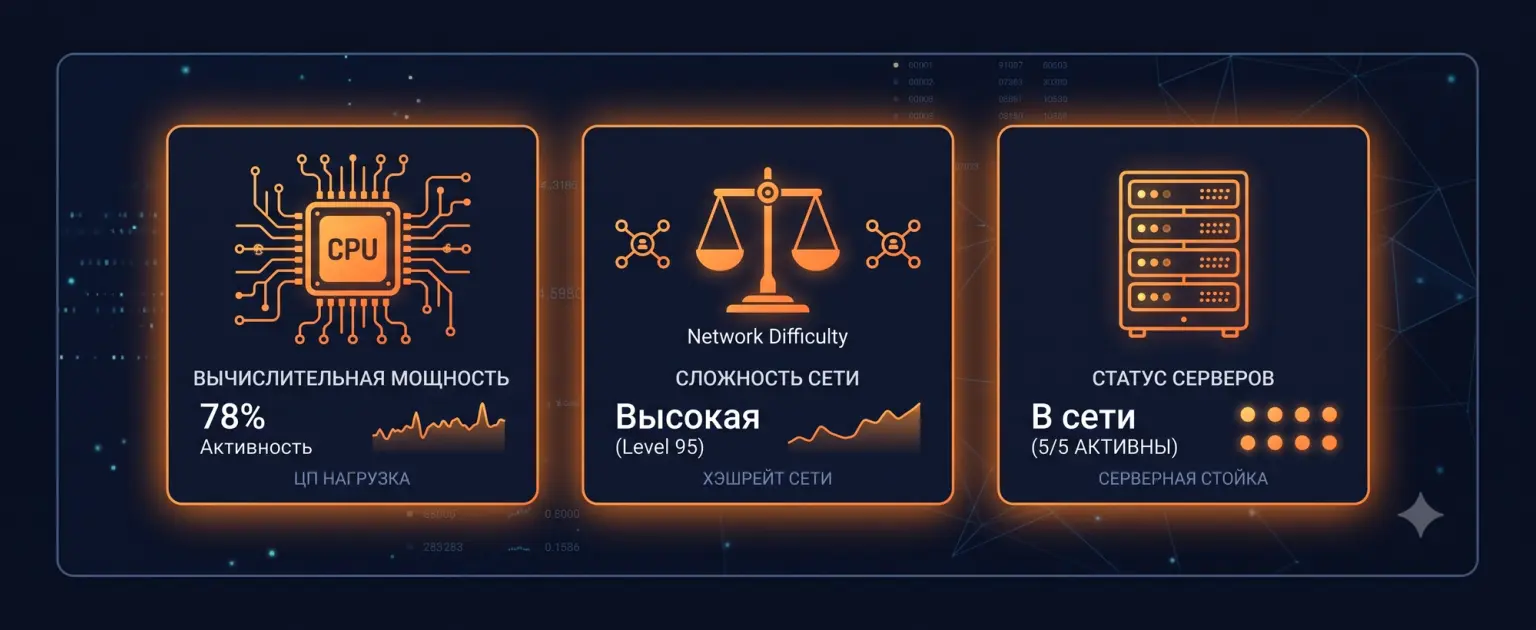
Bitcoin's network hashrate currently sits around 886 EH/s (exahashes per second), according to CoinWarz. That's notably below the 2026 peak, which topped 1,000 EH/s — the decline tracks bitcoin's price drop earlier in the year, which pushed miners to shut down unprofitable rigs.
What hashrate actually is, in plain terms
Hashrate is the combined computing power of every computer mining Bitcoin at the same time. Each miner attempts, millions of times per second, to guess a random number that, combined with block data, produces a hash meeting the network's current rules. Hashrate is simply how many of those attempts happen per second, added up across the entire network.
The units scale the same way megabytes and gigabytes do: H/s (hashes per second) → kH/s → MH/s → GH/s → TH/s (terahashes) → PH/s (petahashes) → EH/s (exahashes). The Bitcoin network now operates in the exahash range — meaning quintillions of attempts every second.
How hashrate is actually "taken" — it can't be measured directly
Here's the key nuance: nobody physically connects to every miner on Earth to add up their power — the Bitcoin network is permissionless and anonymous, and miners aren't required to identify themselves. Hashrate is an estimate, calculated from two things visible right on the blockchain: network difficulty and the actual time it took to find recent blocks.
Every 2,016 blocks (roughly every two weeks), the network automatically recalculates difficulty so a new block is found every 10 minutes on average — if blocks are coming faster, total power must have grown, so difficulty goes up; if slower, it goes down. Hashrate is then derived after the fact from the ratio between difficulty and the actual time between blocks.
In numbers, the formula looks like this: hashrate ≈ difficulty × 2³² ÷ 600 seconds (the target block time). That's exactly why it's called an "estimate" — nobody actually knows the real hashrate at any given second; the only publicly available number is an average, calculated after the fact from the blocks that were actually found.
Why a high hashrate actually matters
Hashrate directly determines how expensive it is to attack the network: the higher it is, the more computing power an attacker would need to rent or buy to gain control of the majority of the network and rewrite transaction history — which is exactly why attacking Bitcoin costs hundreds of millions of dollars, while attacking a smaller chain costs a fraction of that.
Hashrate is also directly tied to mining profitability: when bitcoin's price falls, some equipment stops being profitable, miners switch it off, and the network's total hashrate falls along with difficulty. We've already covered how mining actually works in more depth, if you need the basics first.
Who actually makes the hardware
The ASIC market (chips built specifically for mining, nothing else) is highly concentrated: China's Bitmain (the Antminer line) holds roughly 35-40% of the market, MicroBT (Whatsminer) about 25%, and Canaan (Avalon) about 15%. All three are based in China and together produce more than 90% of the mining hardware in the world.
Who's actually mining: the public companies
Finished hardware sits behind specific companies, many of them publicly traded. Among the largest public miners by self-owned hashrate are MARA Holdings and Bitdeer Technologies (each around 70 EH/s), CleanSpark (roughly 46-50 EH/s), plus Riot Platforms and Core Scientific. MARA Holdings alone holds more than 52,000 BTC on its balance sheet — meaning the company doesn't just mine bitcoin, it holds a substantial amount of it as an asset.
We've already covered how miner TeraWulf converted part of its capacity into an AI data center for Anthropic — a trend that's already reached several major miners looking for revenue beyond mining itself in 2026.
Who pools the power together: mining pools
Individual miners rarely work alone — almost all of them join mining pools to split block rewards proportionally to contributed power, rather than waiting on rare individual luck. The pool market is concentrated too: according to CryptoSlate, Foundry USA and AntPool each currently account for roughly 30% of the network — meaning about 60% of Bitcoin's entire hashrate now flows through just two pools. Their combined share was notably lower a year ago — 29% for Foundry USA and 25% for AntPool — so control over the network keeps concentrating in just two hands year over year. The third-largest pool, ViaBTC, handles roughly 11%.
Bottom line
Hashrate isn't some abstract technical metric — it's a direct reflection of how much money and hardware actually stands behind Bitcoin's security. Behind that single EH/s number sits a concrete, traceable chain: chip makers in China → publicly traded mining companies → mining pools that ultimately find the blocks. Understanding that chain explains why Bitcoin's security isn't an abstraction — it's the outcome of real economic competition between these specific players.
This article is for informational purposes only and does not constitute investment advice.

Author
Maks RybalkoReviewer
For the past four to five years, I've been actively interested in the cryptocurrency market, using a variety of tools: trading bots, trading, and long-term investing. I share my personal observations in my articles.
Comments (0)
No comments yet — be the first!
Related articles

How to Trade P2P Safely: A Step-by-Step Guide
P2P trading is growing worldwide — and it's also where scams happen most often. Here's how escrow protects you and what to check before you release funds.
Grok and xAI: The Full Story of Elon Musk's AI
From a "maximally truth-seeking AI" to a $1.25 trillion merger with SpaceX — here's the full history, products, growth, and controversies behind Grok and xAI, in one place.

Crypto Cards That Never Take Your Keys
A new generation of crypto cards — OKX, MetaMask, COCA, Gnosis Pay — lets you spend straight from your wallet instead of pre-loading a card balance. Here's how that works technically, and why it doesn't remove every risk.