
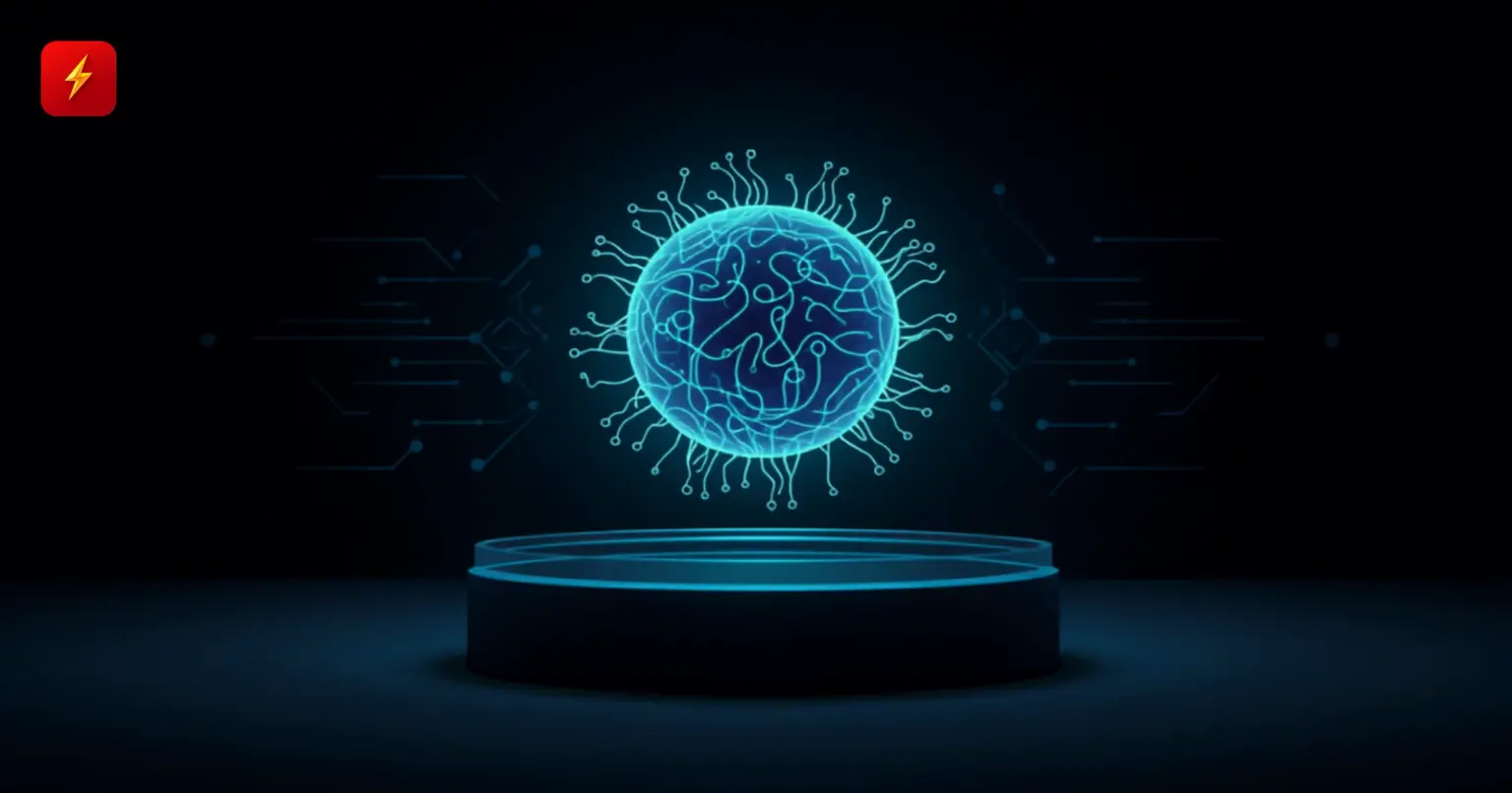
AI is dead, organoids are alive: labs grow computers from brain cells
While the AI industry keeps pouring billions into silicon, a small circle of labs is trying a different substrate entirely: neurons grown from human skin cells. Wired reports that these brain organoids can already play video games, and some researchers now argue they may adapt in ways rigid silicon chips never will.
A brain organoid starts as a skin, blood, hair or tooth sample, reverted to an embryonic stem-cell state, then coaxed to mature into neural tissue. Most stay roughly the size of a chia seed, around 500 micrometers across, though some researchers have pushed a few specimens to 5 millimeters before oxygen deprivation halts further growth. Once assembled, the tissue produces electrical brain-wave patterns similar to those of a premature infant, and it starts wiring itself to whatever environment surrounds it.
Cortical Labs, based in Melbourne, has taken the idea furthest toward a product. Its CL-1 system packages roughly a million living neurons into a toaster-sized biological computer that keeps the tissue alive and responsive for about six months. The company's neurons learned to play Pong back in 2022, and by 2026 they had moved on to Doom, with the longest recorded Pong rally reaching ten consecutive accurate hits.
“How can you have a truly adaptable, flexible system in an inflexible substrate?”
— Brett Kagan, COO, Cortical Labs
At UC San Diego's Sanford Stem Cell Institute, developmental biologist Alysson Muotri has kept one organoid alive for three years, a record for the field, while using the tissue to study autism and the effects of space radiation on developing neurons. His lab's organoids display the same drive researchers keep observing across the field: given almost any environment, neural tissue tries to build connections rather than stay inert.
“Consciousness is so qualitative. How am I supposed to measure something qualitative on a tissue that's floating in a dish?”
— Annie Kathuria, organoid researcher, Johns Hopkins University
Funding is starting to follow the research. The NIH stopped funding animal-testing-only studies in July 2025 and began pushing labs toward what it calls new approach models, organoids among them, and followed that in September 2025 with an $87 million investment in a Standardized Organoid Modeling Center. Beyond computing, backers see a drug-screening use case: roughly 95% of neuropsychiatric drug candidates that pass animal trials still fail in humans, and organoid tissue offers a closer proxy without a live patient.
- Cortical Labs' CL-1 sustains about 1 million living neurons for roughly six months and now plays Doom, up from Pong in 2022
- UC San Diego has kept a single organoid alive for three years, the field's current record
- NIH committed $87M in September 2025 to a Standardized Organoid Modeling Center after halting animal-only-testing funding
- About 95% of neuropsychiatric drugs that clear animal trials still fail in human trials, one reason organoids attract drug-screening interest
The comparison to silicon AI is not incidental. Chipmakers keep chasing cooler, denser materials, including AI-assisted searches for better chip compounds, while executives like Mark Zuckerberg keep publishing sweeping visions for where large language models take society, as in his own recent AI manifesto. Organoid researchers are considerably more cautious about their own field: nobody working with living neural tissue is claiming it thinks, and most say they can't yet even define what measuring that would look like.
Nothing here should be taken as financial advice — just information to consider.

Comments (0)
No comments yet — be the first!
Related news



Most readTop 7

Silicon Valley Workers Are Wearing Noise-Cancelling Masks to Dictate AI Prompts
228AI

