
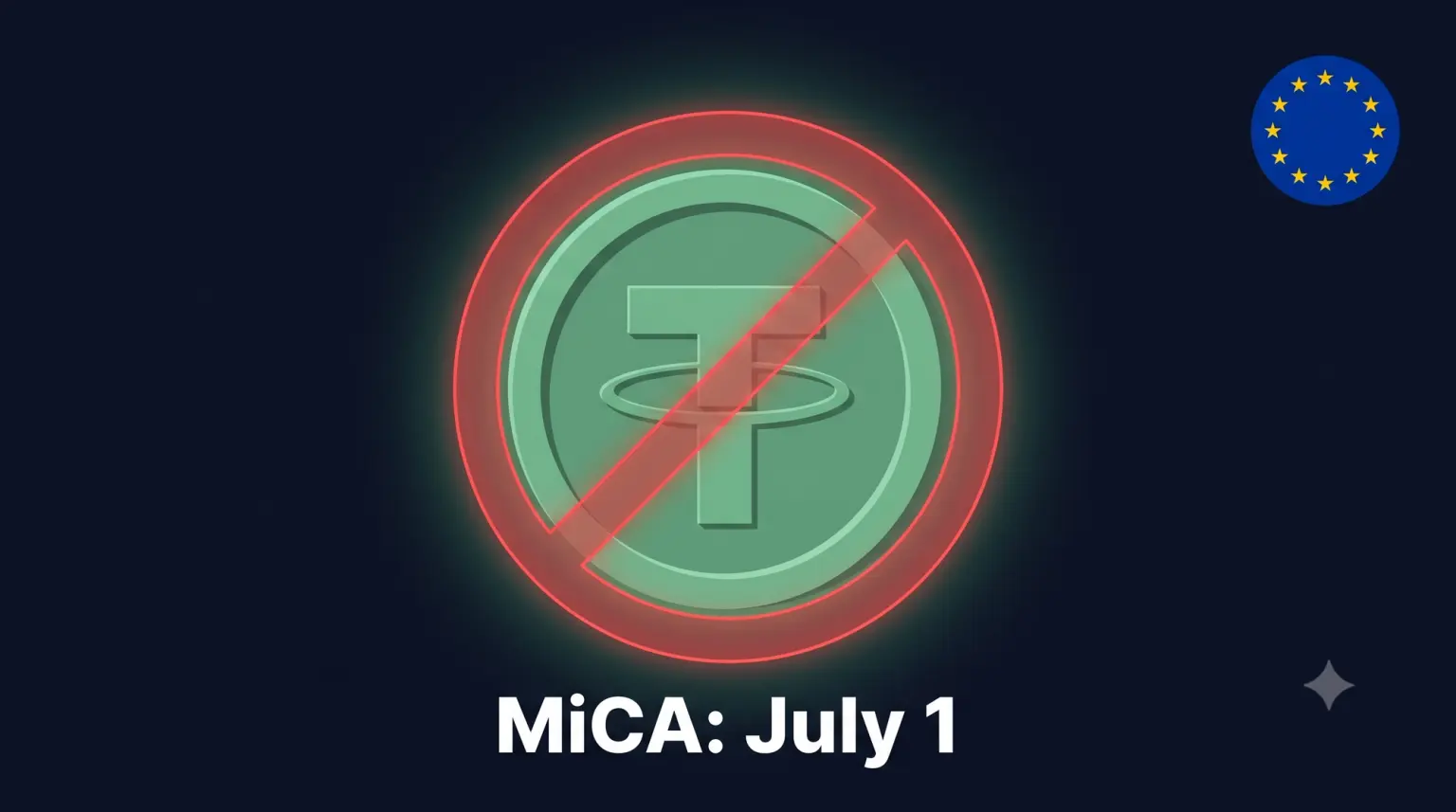
USDT Has Disappeared From European Exchanges: How Tether Lost the MiCA Bet and What It Means for Traders
As of July 1, 2026, no MiCA-licensed exchange in the European Union can offer USDT trading to clients — even though USDT is the world's largest stablecoin, with a market cap of roughly $186 billion. MiCA requires stablecoin issuers to obtain e-money-token authorization, CryptoBriefing explains. Tether never applied. The full consequences of that decision take effect today.
Why Tether refused to get a MiCA license
Tether didn't simply miss the deadline — it deliberately opted out. The core disagreement: MiCA requires stablecoin issuers to hold 30% to 60% of reserves as deposits in EU-supervised banks. Tether CEO Paolo Ardoino described this as a structural risk: concentrating reserves in EU bank deposits creates a single point of failure if a counterparty bank runs into trouble, Vaultody notes. Instead of pursuing the European path, Tether pivoted to the US: the company is seeking authorization under America's GENIUS Act and has already launched a stablecoin called USAT in partnership with Anchorage Digital Bank.
"Requiring 30–60% of reserves to sit in EU bank deposits concentrates risk with a single counterparty — the bank. That threatens the stablecoin's own stability during a liquidity crisis" — Paolo Ardoino, CEO of Tether.
Delisting timeline: who removed USDT and when
Major licensed exchanges began shedding USDT well ahead of the deadline, as Phemex documents:
December 2024 — Coinbase announces delisting of non-MiCA stablecoins for EEA users.
January 2025 — Crypto.com stops offering USDT to EU customers (conversion window closes March 31).
March 2025 — Binance announces delisting of nine stablecoins including USDT for EEA users; USDT spot trading pairs in the EEA discontinued.
July 1, 2026 — full enforcement: no licensed EU CASP can list USDT.
What's allowed and what isn't: an important distinction
The ban doesn't mean USDT has fully disappeared from Europe, Forklog notes. MiCA restricts licensed service providers — exchanges, custodians, brokers. But: holding USDT in a personal wallet is not prohibited; peer-to-peer USDT transfers are legal; trading USDT on decentralized exchanges (DEXes) is also permitted. The restriction applies specifically to regulated financial intermediaries offering USDT to their customers.
The winner: USDC and EURC
Among the top-10 stablecoins, only two have obtained full MiCA authorization: Circle's USDC and EURC. Liquidity began migrating from USDT pairs to USDC pairs in the first half of 2025, well ahead of today's deadline. Tether's removal from regulated EU venues effectively makes Circle the only large compliant stablecoin issuer for the European market, with USDC cementing itself as the de-facto standard for EU-compliant DeFi protocols and centralized exchange platforms.
Takeaway
The USDT–MiCA story is a clear illustration of how regulatory pressure reshapes market share without directly banning a product. Tether hasn't disappeared — it simply bet on a different jurisdiction. For European traders, this creates a practical fork: move to USDC on licensed platforms, or continue using USDT via DEXes and self-custodial wallets — accepting the trade-off of forgoing the protections MiCA provides.
This article is for informational purposes only and is not investment or legal advice. Verify current terms with the platform you use.
Comments (0)
No comments yet — be the first!
Related news



Most readTop 7

Silicon Valley Workers Are Wearing Noise-Cancelling Masks to Dictate AI Prompts
234AI

