Perfect Storm: Four Reasons Why June 2026 Was Bitcoin's Worst Month Ever
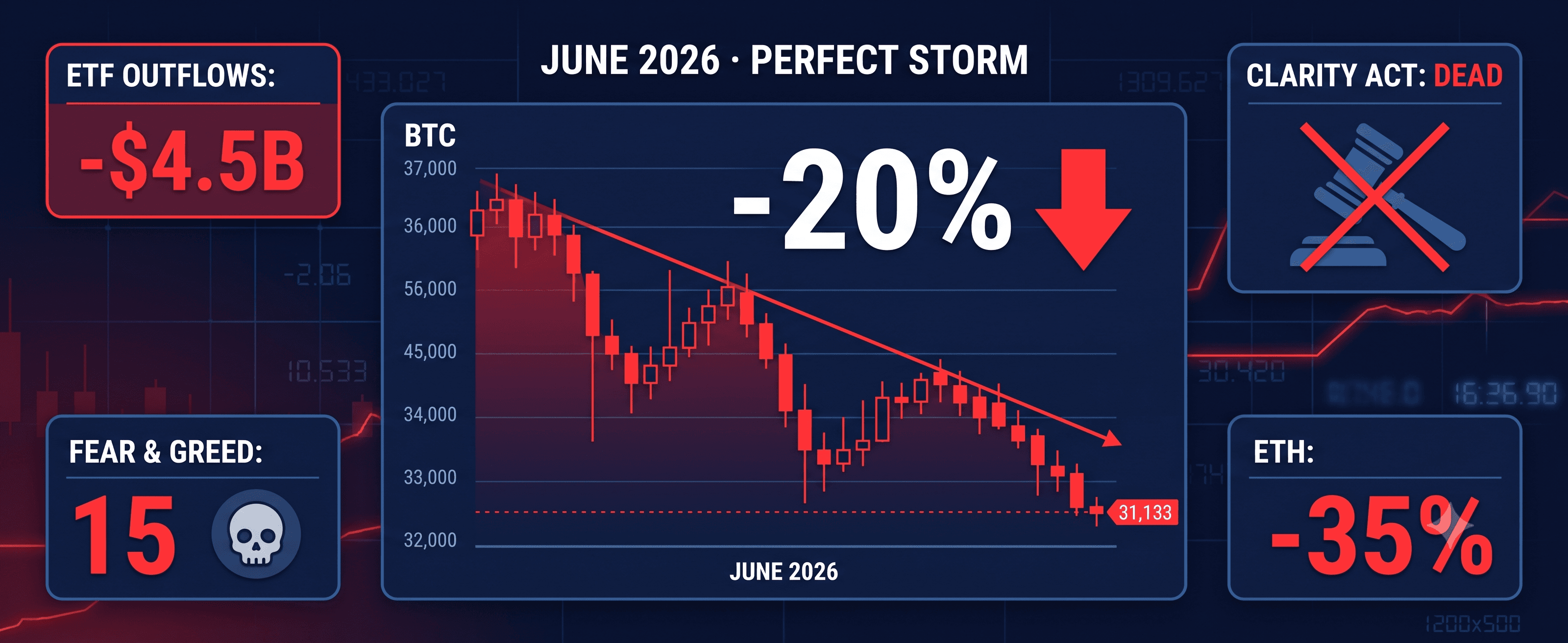
June 2026 will go down in crypto history as the month of the perfect storm. Bitcoin lost 20% in 30 days, closing the month at a 21-month low of $57,950. Ethereum fell below $2,000 — down 35% from its May level. American spot Bitcoin ETFs shed $4.5 billion in net outflows — a record since their launch. The total crypto market cap shrank by $2 trillion from its peak. The Fear & Greed index hit 15 — the extreme fear zone, Intellectia AI reports.
None of these events were random. Each has a specific cause. And all four converged in a single calendar month.
Trigger #1: The Fed removed all hope of rate cuts
June began with a blunt signal from the Federal Reserve. Fed Chair Kevin Warsh released an updated dot-plot that removed rate cuts from the next two meetings. Simultaneously, labor market data showed employment growing faster than forecast. The message was clear: there would be no monetary easing in the near term.
For crypto, the signal proved critical. Since 2020, Bitcoin has traded as a high-risk asset with high rate sensitivity: when the cost of money rises, institutional investors cut exposure to risk instruments. The narrative of BTC as "digital gold" — a protective asset uncorrelated with monetary policy — once again failed to hold up against reality.
Trigger #2: SpaceX IPO pulled $15B from risk assets
June 12 saw the long-awaited SpaceX IPO. The order book was massively oversubscribed — investors were reallocating capital from volatile assets into Elon Musk's company. Analysts estimated that at least $10–15 billion was rotated out of crypto positions to fund IPO participation.
It was precisely on June 12 — IPO day — that Bitcoin ETFs recorded one of the largest single-day outflows in their history. The timing was not coincidental: hedge funds and family offices holding BTC as "alternative growth" rotated capital into an aerospace technology bet.
Trigger #3: Strategy sold Bitcoin — for the first time ever
The most psychologically damaging blow came from Strategy. Founder Michael Saylor had for years declared a "never sell" principle — not a single satoshi regardless of market conditions. In June, Strategy sold a portion of its Bitcoin reserves for the first time in the company's history. The transaction size was symbolic relative to the overall portfolio, but the symbolism was devastating: the largest corporate Bitcoin holder had broken its vow. The market interpreted this as a distress signal, Intellectia AI reports.
Wave-like selling from other corporate holders followed. The Coinbase Premium Index — the price difference between US exchanges and global markets — fell to -0.15%, meaning US institutional buyers had effectively left the market entirely.
Trigger #4: CLARITY Act died, regulatory vacuum continues
By late June it became clear: the CLARITY Act — the main US crypto bill — would not pass before its July 4 deadline. Two negotiating tracks collapsed, and Polymarket odds for 2026 passage crashed from 74% to 48%. For institutional investors waiting for regulatory clarity as an entry signal, this was the final argument for cutting positions.
Without a legislative framework, BTC, ETH and SOL remain in the SEC's potential enforcement jurisdiction. Exchanges operate in a legal gray zone. Large institutional capital — pension funds, insurance companies, sovereign wealth funds — cannot enter the market without a clear legal status for assets.
The institutional exodus: how ETFs became a mirror of the crash
Spot Bitcoin ETFs became an accurate barometer of institutional sentiment. June 2026 was the worst month in their history: $4.5 billion in net outflows, 13 consecutive days of redemptions. BlackRock's IBIT, the largest fund with ~75% market share, lost $3.3 billion in just the 13-day streak. Total assets under management fell from $100+ billion to ~$81 billion, Blockonomi reports.
"Institutional investors entering Bitcoin via ETFs responded to the same macro signals as when selling growth stocks — rates higher, liquidity lower, exit" — analyst cited by Blockonomi.
The structure of sellers is also telling. The bulk of IBIT outflows came not from retail investors, but from hedge funds and family offices that used the ETF as a short-term tactical allocation tool. When the macro picture shifted — they exited.
June's paradox: who was buying while everyone sold
Amid the mass institutional exit, on-chain data told the opposite story. Large wallets (1,000+ BTC) accumulated 270,000 Bitcoin in 30 days — the largest monthly accumulation since 2013. 2,140 addresses expanded positions; Whale Accumulation Trend Score reached 0.68.
Separately, in the DeFi derivatives market, Hyperliquid's HYPE token attracted $150 million in ETF inflows even during the crash — investors were betting on instruments with real revenue from trading fees, not on speculative assets.
The gap between large and small holders' behavior in June 2026 was the widest since 2020. Smart money was buying what retail was selling.
What's next: three scenarios for H2
The key catalyst for the coming weeks is the Fed meeting on July 28–29. On July 1, Chair Warsh already shifted tone, stating that inflation risks had come down. Bitcoin immediately bounced from $57,950 back above $60,000. If the FOMC signals a possible September rate cut, that will be the first serious bullish catalyst of the year.
The second factor is CLARITY Act. The bill still has one window before the August recess. Passage before end of July would bring institutional interest back to the market within weeks.
Technically, Bitcoin is holding $59,400 as near-term support. Above that — a path to $62,000, then the 100-day moving average near $71,500. Four leading AI models (ChatGPT, Grok, Gemini, Copilot) are unanimous: BTC will cross $100,000 in H2 2026. June's storm was brutal — but it was not a structural trend reversal.
"Panic is not a strategy. Crypto history shows: the biggest losses go to those who sell at maximum fear, and the biggest gains — to those who buy then."
This article is for informational purposes only and does not constitute investment advice.

Author
Jonathan
Editor
I love writing about cryptocurrency, am interested in general trends, and try to reflect this in my materials.
Comments (0)
No comments yet — be the first!
Related articles

How a Blockchain Transfer Works: A Plain-Language Guide
Where do funds go when you send crypto? Why does a transfer arrive in seconds and can't be reversed? Where is cryptocurrency actually 'stored'? I explain the whole process step by step — no formulas, no code, just plain language.

What Is Crypto Mining: How Computers Create Bitcoin
Why do miners consume entire warehouses of electricity? What exactly does a computer 'mine'? Where do new bitcoins come from, and is mining profitable in 2026? A plain-language guide — from Satoshi's first laptop to industrial farms in Texas.
19 Days Banned: The US Has Lifted Export Controls on Anthropic's Fable 5 and Mythos 5
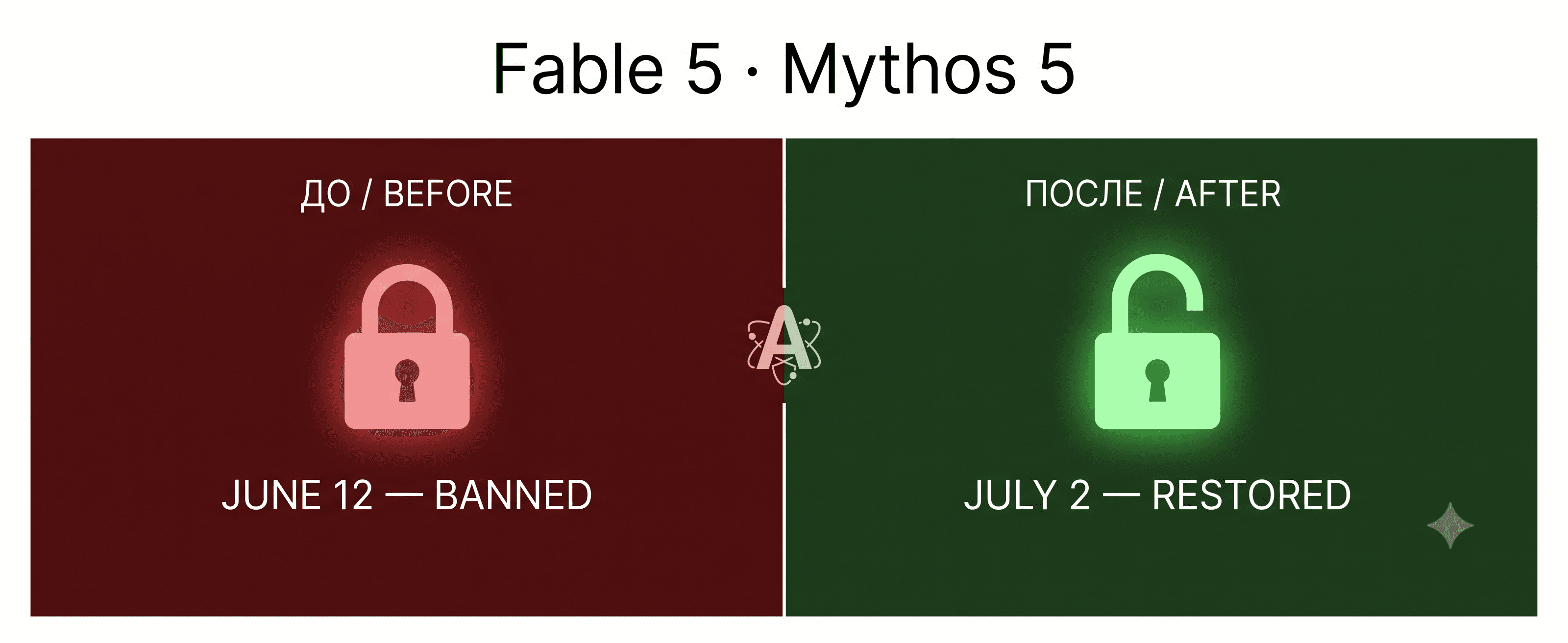
The US Department of Commerce has formally lifted export controls on Anthropic's Claude Fable 5 and Mythos 5 models. The restrictions lasted 19 days — from June 12, when authorities discovered a jailbreak vulnerability. From July 2, access to Fable 5 is restored globally on claude.ai, Claude Code and the API.