What is an ETF: a complete guide for anyone who wants to finally understand it
You can hear the word ETF in almost any conversation about investing today — from classic S&P 500 index funds to the recently launched bitcoin ETFs. But what actually is an ETF, how is it different from a regular mutual fund, and how do you even put money into one? Here's the full, plain-language breakdown — from the history of how ETFs came to be, to how to read your own gains or losses.
What an ETF Actually Is
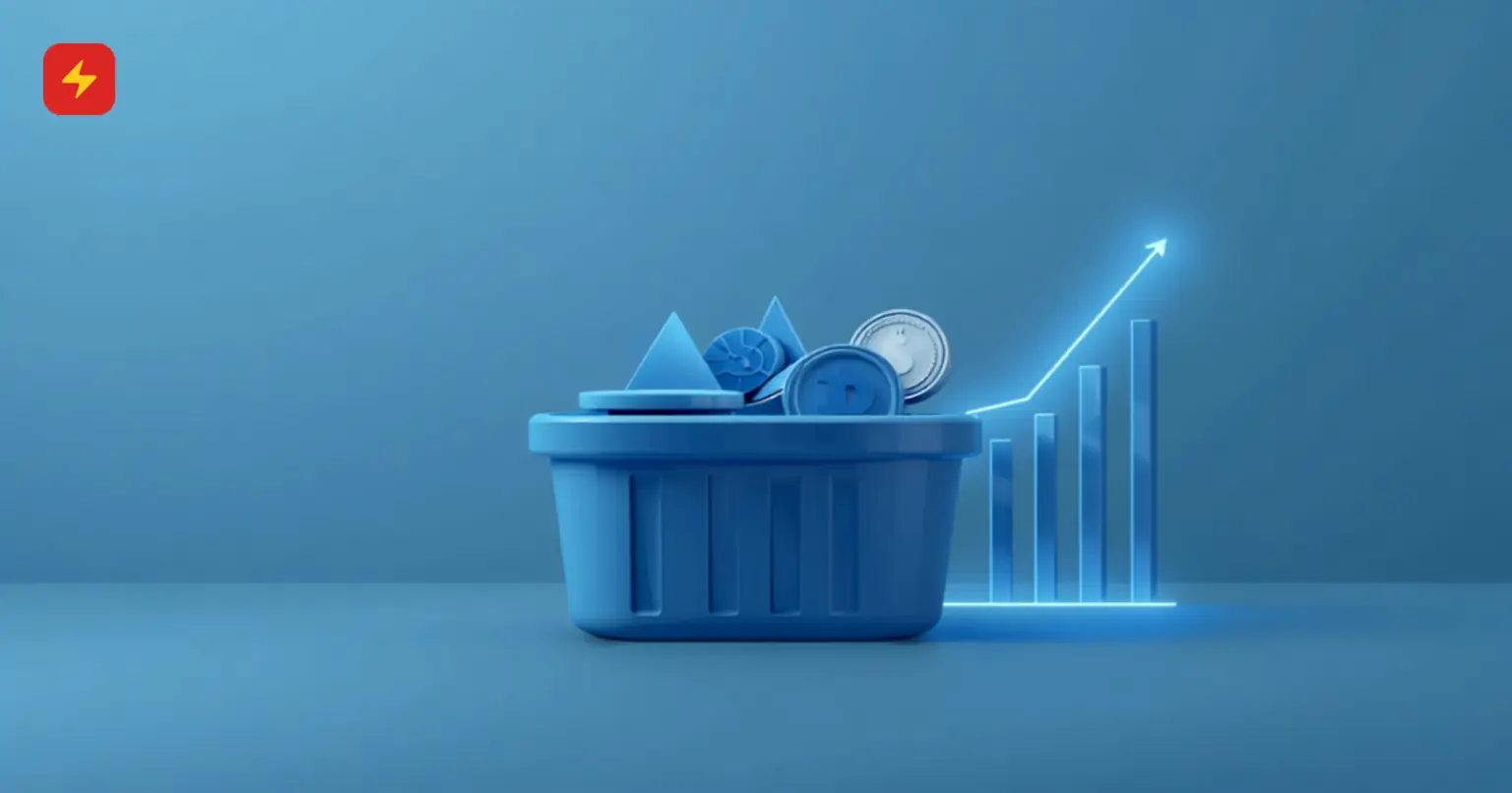
An ETF (Exchange-Traded Fund) is an investment fund that holds a basket of assets — stocks, bonds, commodities, or even cryptocurrency — but trades on an exchange exactly like an ordinary stock, meaning it can be bought and sold at any point during the trading session at the current market price. By buying one share (or unit) of an ETF, an investor is effectively buying a small slice of every asset inside the fund at once — that's the whole point of the instrument: instant diversification in a single trade.
That's essentially how John Bogle, the founder of Vanguard and the godfather of index investing, described the philosophy behind the idea, even before the term "ETF" existed:
Don't look for the needle in the haystack. Just buy the haystack. — John Bogle, founder of Vanguard
In the case of an ETF, the "haystack" might be all 500 largest US companies at once, bought in a single trade instead of trying to guess which individual one will outperform the rest.
Where ETFs Came From: A Brief History
The world's first exchange-traded fund wasn't launched in the US, but in Canada: on March 9, 1990, the Toronto 35 Index Participation Units (TIPs) began trading on the Toronto Stock Exchange, tracking the 35 largest companies listed there. Notably, an American attempt to create a similar instrument a year earlier had failed: Index Participation Shares were quickly withdrawn after a successful lawsuit from the Chicago Mercantile Exchange.
The first true US ETF didn't arrive until three years later: on January 22, 1993, the SPDR S&P 500 ETF Trust (ticker: SPY) began trading on the AMEX — the brainchild of the late Nate Most, launched with just $6.53 million in assets. SPY kicked off an industry that today is valued at over $2.1 trillion in the US alone and includes more than 1,700 funds.
The next major breakthrough came more than 30 years later: on January 10, 2024, the US Securities and Exchange Commission (SEC) approved the first spot bitcoin ETFs — 11 applications at once, including funds from BlackRock, Fidelity, Invesco, and Grayscale. Trading began on January 11, 2024, and total trading volume across the new bitcoin ETFs hit $4.6 billion on day one alone. By March 2024, BlackRock's IBIT and Fidelity's FBTC had already captured 79% of all inflows into the new crypto ETFs.
Why ETFs Exist in the First Place
The main reason for ETFs' popularity is a combination of advantages that are hard to get simultaneously from any other instrument:
- Instant diversification — instead of buying dozens of individual stocks, an investor gets a ready-made basket of assets
- Low costs — fees on most index ETFs run a fraction of a percent per year, while actively managed mutual funds often charge 1–2%
- Liquidity — ETF shares can be bought and sold at any point during trading, unlike mutual funds, which are only priced once a day
- Transparency — most ETFs publish their holdings daily, so investors always know exactly what they own
This same principle underlies Warren Buffett's famous advice to ordinary investors:
In my view, for most people, the best thing to do is to own the S&P 500 index fund. — Warren Buffett, at Berkshire Hathaway's annual meeting
And separately, on why complex strategies often lose to simply owning the index:
Costs really matter in investments. If returns are going to be seven or eight percent and you're paying one percent for fees, that makes an enormous difference in how much money you're going to have in retirement. — Warren Buffett
The Main Types of ETFs
- Index ETFs — the most common type, tracking a specific market index (S&P 500, Nasdaq-100, MSCI World)
- Sector and industry ETFs — focused on a specific industry: technology, healthcare, energy
- Fixed-income ETFs — made up of government or corporate bonds, typically used to lower overall portfolio risk
- Commodity ETFs — provide exposure to gold, oil, or other raw materials without needing to buy the physical asset
- Actively managed ETFs — unlike index ETFs, where holdings change mechanically to track an index, here a management team makes its own portfolio decisions
- Leveraged and inverse ETFs — amplify the daily move of the underlying asset by 2–3x or bet against it; considered high-risk instruments for short-term trading rather than long-term investing
- Crypto ETFs — the newest category, providing access to bitcoin or ethereum through a regular brokerage account without needing a wallet or an exchange account
Where ETFs Are Most Popular
The undisputed leader is the US — it's home to the bulk of global ETF assets under management and the most well-known funds, like SPY, QQQ, IBIT, and VOO. The second-largest market is Europe, where ETFs are issued in the UCITS format — these funds are available to investors across multiple EU countries at once and are typically listed in euros and pounds on exchanges in London, Frankfurt, and Dublin. Canada, which gave the world its first-ever ETF, also remains a large and mature market — many of the industry's structural innovations were tested there first.
How to Invest in ETFs: Step by Step
- Open a brokerage account — with most modern brokers, this can be done online in a few minutes
- Define your goal — broad market growth, bond income, inflation protection through commodity ETFs, or a targeted bet on a specific sector
- Compare costs — pay attention to the total expense ratio (TER) or management fee: even a 0.5% annual difference can critically affect your result over a long horizon
- Buy ETF shares through your broker's trading platform the same way you'd buy any stock — at market price or via a limit order
- Hold for the long term — most index investing experts advise against trying to time the market, and instead recommend regularly buying more shares and holding them for years
How ETFs Show Profit or Loss
Every ETF has two key figures that are important not to confuse. The first is Net Asset Value (NAV): the calculated value of one share based on the total value of all the fund's assets divided by the number of shares outstanding. The second is the market price — the price at which a share actually trades on the exchange at any given moment; due to supply and demand, this can deviate slightly from NAV, though for liquid ETFs that gap is usually minimal.
Your personal profit or loss on an ETF comes from two sources. The first is the change in the share price itself: if you bought an ETF at $100 and it's now trading at $115, your unrealized gain is $15 per share until you sell. The second source is dividends or distributions: if the ETF holds dividend-paying stocks or coupon-bearing bonds, the fund periodically pays out that money to shareholders — either directly to your account or automatically reinvested into additional shares, depending on your brokerage account settings.
Your total return from an ETF investment is the sum of the share price change plus all dividends or coupons received over the holding period, minus the fund's fee, which is deducted from assets gradually and is already reflected in the NAV's trajectory.
ETFs vs. Mutual Funds: What's the Difference
New investors are often confused because ETFs and classic mutual funds seem, at first glance, to solve the same problem — diversified ownership of a basket of assets. The difference is in the mechanics. Mutual fund shares are bought and sold only once a day, at a price calculated after markets close — so a morning buy order actually executes at that evening's price, which you don't know in advance. An ETF, by contrast, trades in real time throughout the entire session, and you see the exact execution price the moment the trade happens.
The second major difference is tax efficiency. Thanks to a special creation/redemption-in-kind mechanism, most US ETFs are less often forced to sell assets inside the portfolio and therefore generate taxable capital gains for shareholders less frequently than mutual funds do — one reason many investors have gradually been shifting from mutual funds into ETFs in recent years.
Frequently Asked Questions About ETFs
Can you lose all the money invested in an ETF? Theoretically yes, if every asset inside the fund simultaneously fell to zero — but for broad index ETFs that's an extremely unlikely scenario requiring an actual collapse of the whole market. The risk is far higher for narrowly focused, leveraged, or crypto ETFs, where the underlying asset's volatility is already significantly higher on its own.
Do you need a large starting capital? No — most brokers let you buy just a single ETF share, and one share of a popular fund typically costs anywhere from a few dozen to a few hundred dollars; some brokers also offer fractional shares.
What happens if the management company closes an ETF? This does happen with funds that fail to attract enough assets under management. In that case, the company notifies shareholders in advance and liquidates the fund, returning investors the cash equivalent of their stake at current market value — usually without requiring the investor to take any action themselves.
How Crypto ETFs Are Different
Spot bitcoin and ethereum ETFs physically hold the cryptocurrency through a regulated custodian rather than derivative contracts — which is exactly why getting them approved required the SEC to run a separate, lengthy regulatory process spanning years of litigation and applications. For an everyday investor, a crypto ETF solves one specific practical problem: getting economic exposure to bitcoin's or ethereum's price through a familiar brokerage account, without needing to store private keys yourself, deal with crypto exchanges, or worry about the security of a personal wallet. The tradeoff is that the shareholder doesn't own the cryptocurrency directly and can't, for example, withdraw it to their own wallet or use it in DeFi protocols.
What to Keep in Mind Before Buying
An ETF is not a risk-free instrument: a share's value can rise or fall along with its underlying assets, and narrowly focused, leveraged, or inverse ETFs can be significantly more volatile than the broad market. Still, for most retail investors, a simple, cheap, diversified index ETF remains one of the most time-tested ways to participate in market growth — from the classic S&P 500 to the recently launched bitcoin ETFs, which attracted tens of billions of dollars in investment in just a couple of years.
This material is for informational purposes only and is not investment advice.

Author
Maks RybalkoReviewer
For the past four to five years, I've been actively interested in the cryptocurrency market, using a variety of tools: trading bots, trading, and long-term investing. I share my personal observations in my articles.
Comments (0)
No comments yet — be the first!
Related articles

What is Silicon Valley, and why does the whole world move there
Where the name "Silicon Valley" actually comes from, where it's really located, and why this small stretch of California became the birthplace of Apple, Google, Intel, and HP. Here's the history explained simply.

The story of Binance: from a $15M ICO to the world's biggest exchange
In eight years, Binance went from a $15M ICO to an exchange with 300 million users and $34 trillion in annual volume — surviving a $40M hack, a $4.3 billion fine, and its founder's prison sentence. Here's the full story, from launch to a presidential pardon.

Terra and Luna: how $40 billion vanished in a week
The algorithmic stablecoin UST ran on a 19.5% yield and a promise — until one week in May 2022 wiped out $40 billion and its creator, Do Kwon, was sentenced to 15 years in prison. Here's the full story of Terra, from launch to sentencing.
Most read
Silicon Valley Workers Are Wearing Noise-Cancelling Masks to Dictate AI Prompts
160 views
Elon Musk Expands Access to X Money, the Payments Service Inside X
152 views
Strategy Didn't Buy Any Bitcoin Last Week — and Now Has a Plan to Sell It
45 views
Layer-2: How Blockchains Get Faster Without Touching the Base Chain
42 views
Crypto Cards That Never Take Your Keys
31 views
Crypto Market Drops 4-5% in a Day: What Volume and Traders Are Saying
31 views
DeepSeek Made Its Founder the World's Richest AI Creator — His Fortune Just Doubled to $36 Billion
28 views