
DTCC Chose Stellar to Tokenize Russell 1000 Stocks and US Treasuries — Live Tests Begin July 13
On July 13, 2026, DTCC — America's largest clearinghouse — will launch the first live production tests of its tokenization platform on the Stellar blockchain. The assets on the line: stocks from the Russell 1000 index, major index ETFs, and U.S. government bonds. Stellar has become the first public blockchain in the company's multi-chain strategy — a company that settles more than $2 trillion in securities trades every day, CoinDesk reports.
What DTCC is and why this matters
DTCC (Depository Trust & Clearing Corporation) is the invisible foundation of the American securities market. Through its subsidiary DTC (Depository Trust Company), virtually every US stock and bond trade goes through settlement. Until now, that infrastructure belonged exclusively to traditional finance — no public blockchains. The Stellar partnership marks the first time assets held by DTC will get an on-chain representation on an open public network, Genfinity notes.
How the dual-record system works
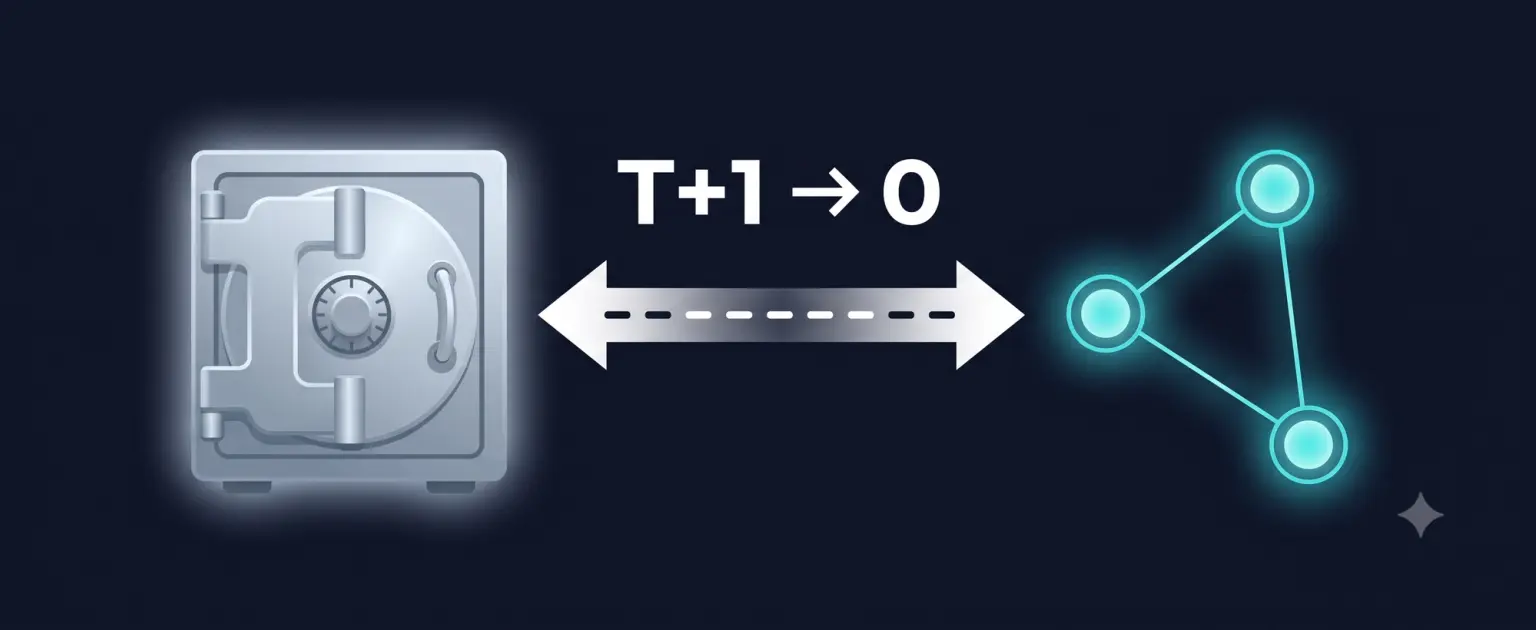
The structure was deliberately designed not to disrupt the existing legal order. DTC retains the authoritative legal record — DTC remains the official custodian and source of truth about ownership. Stellar hosts a synchronized on-chain representation of the same asset — a "mirrored record" used for digital settlement. The practical effect: settlement compresses from T+1 (the next business day) to near-instantaneous finality — freeing up collateral, reducing counterparty risk, and enabling transactions outside standard trading hours, crypto.news explains.
Why Stellar and not Ethereum or Solana
Stellar wasn't chosen for speed or ecosystem size — both Ethereum and Solana outrank it on those metrics. The decisive advantage is Stellar's compliance architecture, built directly into the protocol: the ability to freeze or claw back tokens, transfer restrictions, and embedded identity controls. These are precisely the mechanisms a regulated financial institution needs when it cannot allow uncontrolled movement of assets. DTCC's 2023 acquisition of Securrency — a developer that had spent years building compliance infrastructure on Stellar — was equally important in the decision.
"Blockchain is excellent at books and records. The base layer is always going to be open. Then the institution gets to decide how compliance and privacy come into play" — Denelle Dixon, CEO of the Stellar Development Foundation.
The road to July 13: a timeline
2019: Franklin Templeton begins testing Stellar for tokenized financial products.
2021: Launch of BENJI, the first tokenized money market fund on Stellar for institutional use.
2023: DTCC acquires Securrency; the division is rebranded as DTCC Digital Assets.
December 2025: The SEC issues a no-action letter: DTCC receives permission to tokenize Russell 1000 stocks, ETFs, and US Treasuries.
May 27, 2026: DTCC officially announces the connection of its tokenization platform to Stellar. XLM +14%.
July 13, 2026: First live production tests on Stellar.
October 2026: Planned wider rollout.
H1 2027: Full availability of DTC-custodied assets on the Stellar network.
What it means for the market
The significance of this partnership goes well beyond a single blockchain. DTCC isn't a startup or a proof of concept: it's systemic infrastructure that trillions of dollars in daily settlement flow through. Choosing a public blockchain (rather than a private network) is a principled decision: it means tokenized assets will, in principle, be able to interact with any DeFi protocol or platform that connects to Stellar. DTCC's multi-chain strategy envisions other blockchains joining the system down the line — Stellar is just the first. The tokenized US Treasury market has already reached roughly $15 billion, and institutional infrastructure at this scale could accelerate its growth by an order of magnitude, CoinDesk notes.
Takeaway
The DTCC–Stellar integration isn't another "blockchain for the sake of it" pilot. It's the first time the central depository of the world's largest stock market is moving real assets onto an open public blockchain — with a concrete test date and a roadmap through 2027. For XLM, it represents long-term structural demand. But the larger significance isn't the token price — it's that the line between TradFi and on-chain infrastructure just got one step thinner.
This article is for informational purposes only and is not investment advice.
Comments (0)
No comments yet — be the first!
Related news

Most readTop 7

Silicon Valley Workers Are Wearing Noise-Cancelling Masks to Dictate AI Prompts
234AI

