
Robinhood Launched Its Own Blockchain, Stock Tokens for 120 Countries, and AI Trading — Breaking Down Everything Announced in London
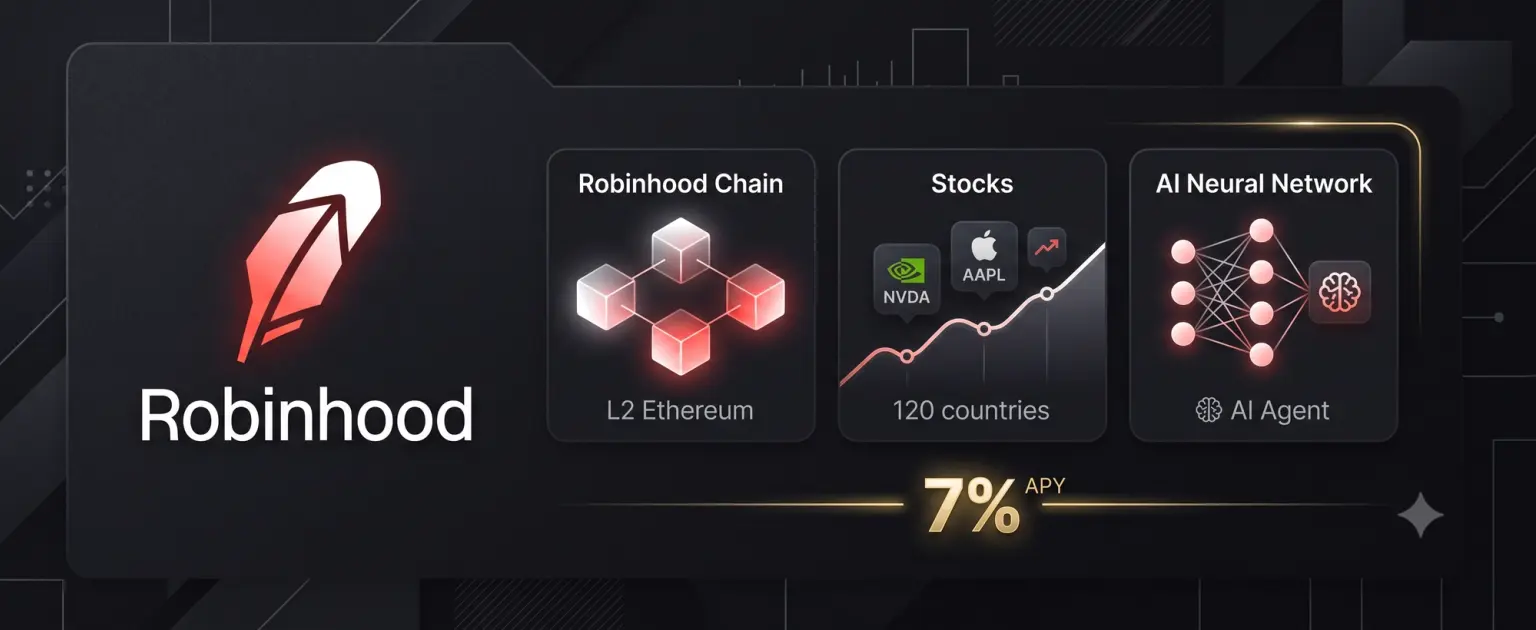
On July 1, 2026, Robinhood held a presentation in London called 'The World Is Flat' and announced four products at once: its own Robinhood Chain blockchain, tokenized stocks for 120+ countries, AI trading agents, and DeFi tools offering up to 7% annual yield. The company that started as a zero-commission broker is betting on becoming a global financial platform built on blockchain, Forbes reports.
Robinhood Chain: what kind of blockchain this is
Robinhood Chain is a public Layer 2 blockchain built on Arbitrum technology on top of Ethereum. The company positions it as 'AI-native' — meaning it was designed from the ground up for algorithmic agents and trading bots. Uniswap AMM and Pleiades are integrated as liquidity mechanisms. In effect, it is the infrastructure layer that all the other products announced in London run on: stock tokens, DeFi lending and perpetual futures.
An important detail: unlike private corporate chains, Robinhood Chain is public. That means any developer or protocol can build applications on it. Robinhood is not closing the ecosystem — it wants to become its hub.
Stock Tokens: equity on-chain for the world, minus the US
The flagship product for international users is Stock Tokens: tokenized representations of shares in major public companies (Nvidia, Apple and others). Available in 120+ countries — but not in the United States due to regulatory constraints. Technically, the tokens are debt instruments redeemable for cash through authorized participants. They can be stored in any compatible wallet (Ledger, Trust Wallet) and traded on decentralized exchanges — Uniswap and 1inch, Crypto Economy reports.
The key difference from past tokenized stock attempts: the new tokens are not locked inside the Robinhood app. The holder controls the asset themselves, through their own wallet. Robinhood plans to eventually add the ability to redeem a token for the underlying share — building a bridge between on-chain assets and a traditional brokerage account. For markets where access to US equities has historically been expensive and inconvenient, this is a meaningful shift.
Agentic Accounts: an AI agent instead of a trader
For US users, Robinhood announced Agentic Accounts — a product that lets you connect any LLM model (such as GPT or Claude) to the platform's data and tools. The AI can analyze markets, build strategies, and — within pre-set parameters — autonomously make purchases through a Robinhood Gold card. Connection and core features are free, CoinDesk notes.
"This really is a continuation of our Cannes event, where Vlad championed the ability for crypto technology and tokenization to improve access to financial services" — Jordan Sinclair, President of Robinhood.
Agentic Accounts is a bet on the trend of autonomous AI agents in finance. Instead of watching the market yourself, you set the rules and the AI executes them in real time. How broadly users are willing to delegate such decisions to an algorithm remains to be seen — the market will decide.
Robinhood Earn and perpetual futures: the DeFi stack
Robinhood Earn is DeFi lending built on the Morpho protocol. Users deposit USDG (Robinhood's own stablecoin) and earn approximately 7% APY. That is a competitive rate relative to traditional bank deposits, though it comes with the smart-contract and liquidity risks inherent to DeFi.
Separately, perpetual futures (no expiry date) were launched on commodities, ETFs and currency pairs with up to 10x leverage, through an integration with the Lighter DEX. Together with Stock Tokens and Earn, this forms a complete on-chain financial stack: equity trading + lending + derivatives — all within one ecosystem on Robinhood Chain.
Why this matters: TradFi and DeFi are no longer separate worlds
By the numbers: in Q1 2026 Robinhood's crypto revenue fell 47% year-over-year, but total revenue rose 15% to $1.07 billion, and platform assets reached $307 billion (up 39% in a year). The company is growing despite the crypto winter — which is exactly why it is betting on tokenized finance, where the potential market is incomparably larger than crypto alone.
Geographically: beyond the UK and Singapore, Robinhood is entering Canada following the WonderFi acquisition. That means access to a G7 audience that traditionally trusts regulated brokers rather than native DeFi protocols.
The key market signal: Robinhood is not simply adding crypto features to a brokerage app — it is building an alternative financial infrastructure. If Stock Tokens build meaningful liquidity outside the US, traditional brokers will have to respond. The next six months will show whether users outside the US are prepared to trust on-chain equities the same way they trust paper ones.
This article is for informational and analytical purposes only. It is not investment advice.
Comments (0)
No comments yet — be the first!
Related articles
The Winklevoss Twins: Rowers, Zuckerberg's Rivals, Bitcoin Billionaires
Cameron and Tyler Winklevoss ended up at the center of two of the last twenty years' biggest tech stories — the birth of Facebook and the birth of the bitcoin industry. We trace their path from suing Mark Zuckerberg to taking their own exchange, Gemini, public on Nasdaq.
Why 11 Crypto Card issuers vanished and the math that decides who's next
At least 11 crypto card issuers have effectively exited the market over the past year. Generis research maps three systemic failure modes — and explains why a card-only model doesn't add up without a wider ecosystem around it.
Mark Zuckerberg: the Harvard student who now spends $140 billion a year on AI
How a Harvard student built the largest social network in history, survived the Winklevoss lawsuit and a failed crypto project called Libra, and turned Meta into one of Silicon Valley's biggest AI bets — with a $140 billion-a-year AI budget.
Most readTop 7

Silicon Valley Workers Are Wearing Noise-Cancelling Masks to Dictate AI Prompts
234AI

