What Is a Gas Fee: Why the Commission Can Cost More Than the Transfer
Anyone who has used Ethereum has lived through this moment: you enter $10 to send, and the gas fee reads $23. More than the transfer itself. You close the app. You have no idea why. I'll explain: where that number comes from, why it happens, and — most importantly — what you can do about it.
Gas: Not What You Put in Your Car
A gas fee is payment for the computing power of the Ethereum network. Think of the blockchain as a public computer used by millions of people simultaneously. Every time someone sends a transaction or runs a smart contract, that computer uses real resources — processor time, memory, bandwidth. Gas is the unit that measures those resources. Without paying gas, your transaction simply won't be processed.
Who receives the payment? Since Ethereum switched to Proof-of-Stake in 2022, fees go to the nodes (validators) that verify transactions and add blocks — though not all of it, as I'll explain. The full technical breakdown is on ethereum.org.
How the Fee Is Calculated
A gas fee has two components:
Gas fee = number of gas units × price per gas unit
The number of gas units depends on how complex the operation is:
Simple ETH transfer: 21,000 units — always fixed.
Token swap on a DEX: 100,000 – 300,000 units.
Complex smart contract (DeFi, NFT mint): 300,000 – 1,000,000+ units.
The price per unit is measured in gwei (gigawei). One ETH = 1,000,000,000 gwei. In practical terms: during quiet periods, gas costs 5–15 gwei; during peak demand it can rise into the thousands.
Example during a quiet period:
21,000 × 10 gwei = 0.00021 ETH ≈ $0.60 (ETH at $2,800)
Example during peak demand:
21,000 × 500 gwei = 0.0105 ETH ≈ $29.40
And if it wasn't a simple transfer but an NFT collection mint (500,000 units × 500 gwei), the total fee could exceed $700. That wasn't hypothetical — it happened in May 2021.
Why Gas Spikes at 'Rush Hour'
Ethereum is like a highway with a fixed number of lanes. Each block has a cap on how many transactions it can hold. When demand exceeds capacity, transactions queue up, and users start offering higher gas prices to jump the line.
When this tends to happen:
NFT collection launches. Thousands of people hitting 'Mint' simultaneously — the network chokes.
Token sales and IDOs. Everyone wants in at the same moment — auction for a block slot.
Market crashes and liquidations. DeFi bots rapidly closing positions en masse, creating gridlock.
"The Ethereum network during the May 2021 NFT boom looked like a highway on a Friday evening: everyone driving at once, everyone paying double, and nobody happy about it."
EIP-1559: How Ethereum Changed the Rules
Before August 2021, it was a pure auction: you named your own gas price, and the highest bidder went first. Predicting the fee in advance was nearly impossible.
In August 2021, the EIP-1559 upgrade went live, changing the model:
Base fee. Set automatically by the network based on congestion — and completely BURNED (destroyed, paid to nobody). You always know exactly what you'll pay to get in.
Priority fee (tip). A small optional add-on that goes directly to the validator as an incentive to process your transaction faster.
The result: fees became more predictable and the model more transparent. But during peak periods, the base fee still surges. EIP-1559 changed the rules — it didn't remove the traffic jams.
Layer 2 — The Real Solution
The most effective way to cut fees is to move to Layer 2 protocols. These solutions run on top of Ethereum, process transactions faster and cheaper, and periodically 'batch' the results onto the main blockchain.
Popular L2s: Arbitrum, Optimism, Base, zkSync. The cost difference is dramatic:
Ethereum L1: simple transfer ≈ $1–5 (normal), $20–100+ (peak)
Arbitrum L2: same transfer ≈ $0.01–0.10
For a live comparison of fees across L2 networks, see l2fees.info. A 50–200× difference is not an exaggeration.
Most major DEX platforms and DeFi protocols are already deployed on L2. If you make frequent small transfers or trade regularly, Layer 2 changes everything.
Practical Tips: How to Pay Less Right Now
Rule one: always check gas levels before sending. The Etherscan Gas Tracker shows the current gwei price and estimated confirmation time at different fee levels.
✦ Timing matters. Gas is cheapest late at night UTC — when the US and Europe are asleep — and on weekends. Peak hours: weekdays 14:00–22:00 UTC.
✦ 'Slow' doesn't mean bad. If your transfer isn't urgent, select low priority. Wait 10–30 minutes and save 40–60%.
✦ Use L2 for recurring activity. Bridge your assets to Arbitrum or Base for everyday use — 99% of operations will cost a fraction of a cent.
✦ Don't act during hype. A major NFT drop just launched? Wait an hour. The gas will fall.
Gas Fees Aren't a Bug — They're Architecture
Fees aren't a scheme to extract money from users. Gas is a market mechanism that determines priority in a block space that is, by design, finite. It's fair in the most literal sense: you pay more, you go faster.
Ethereum is actively building out Layer 2 as its long-term answer. Today, most operations can already be done for fractions of a cent. The main thing is knowing where and when.
This article is for educational purposes only and does not constitute investment advice.

Author
Jonathan
Editor
I love writing about cryptocurrency, am interested in general trends, and try to reflect this in my materials.
Comments (0)
No comments yet — be the first!
Related articles

How a Blockchain Transfer Works: A Plain-Language Guide
Where do funds go when you send crypto? Why does a transfer arrive in seconds and can't be reversed? Where is cryptocurrency actually 'stored'? I explain the whole process step by step — no formulas, no code, just plain language.
What Is Crypto Mining: How Computers Create Bitcoin
Why do miners consume entire warehouses of electricity? What exactly does a computer 'mine'? Where do new bitcoins come from, and is mining profitable in 2026? A plain-language guide — from Satoshi's first laptop to industrial farms in Texas.
Perfect Storm: Four Reasons Why June 2026 Was Bitcoin's Worst Month Ever
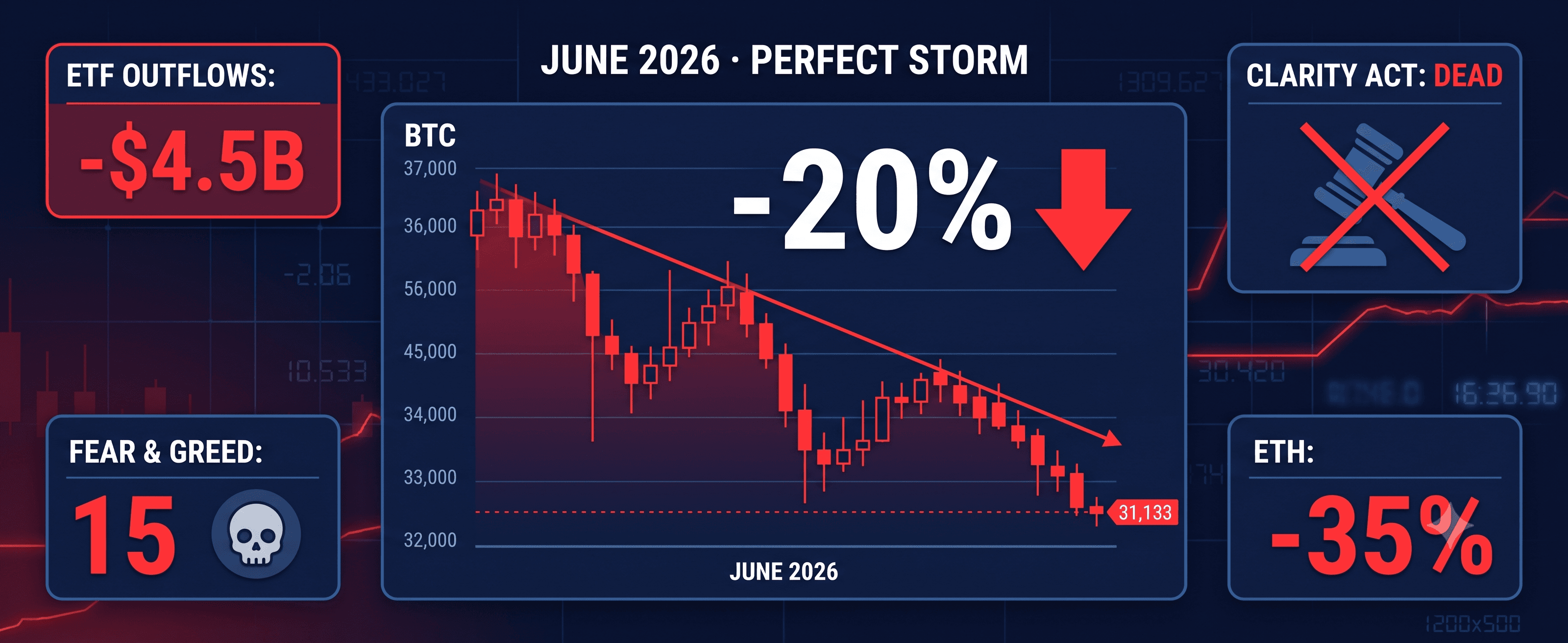
Bitcoin fell 20%, Ethereum dropped 35%, $2 trillion in market cap evaporated. June 2026 was the worst month for crypto since the bull cycle began. We break down the four forces that converged simultaneously to form a perfect storm: the Fed, SpaceX's IPO, Strategy's betrayal, and a regulatory vacuum.