
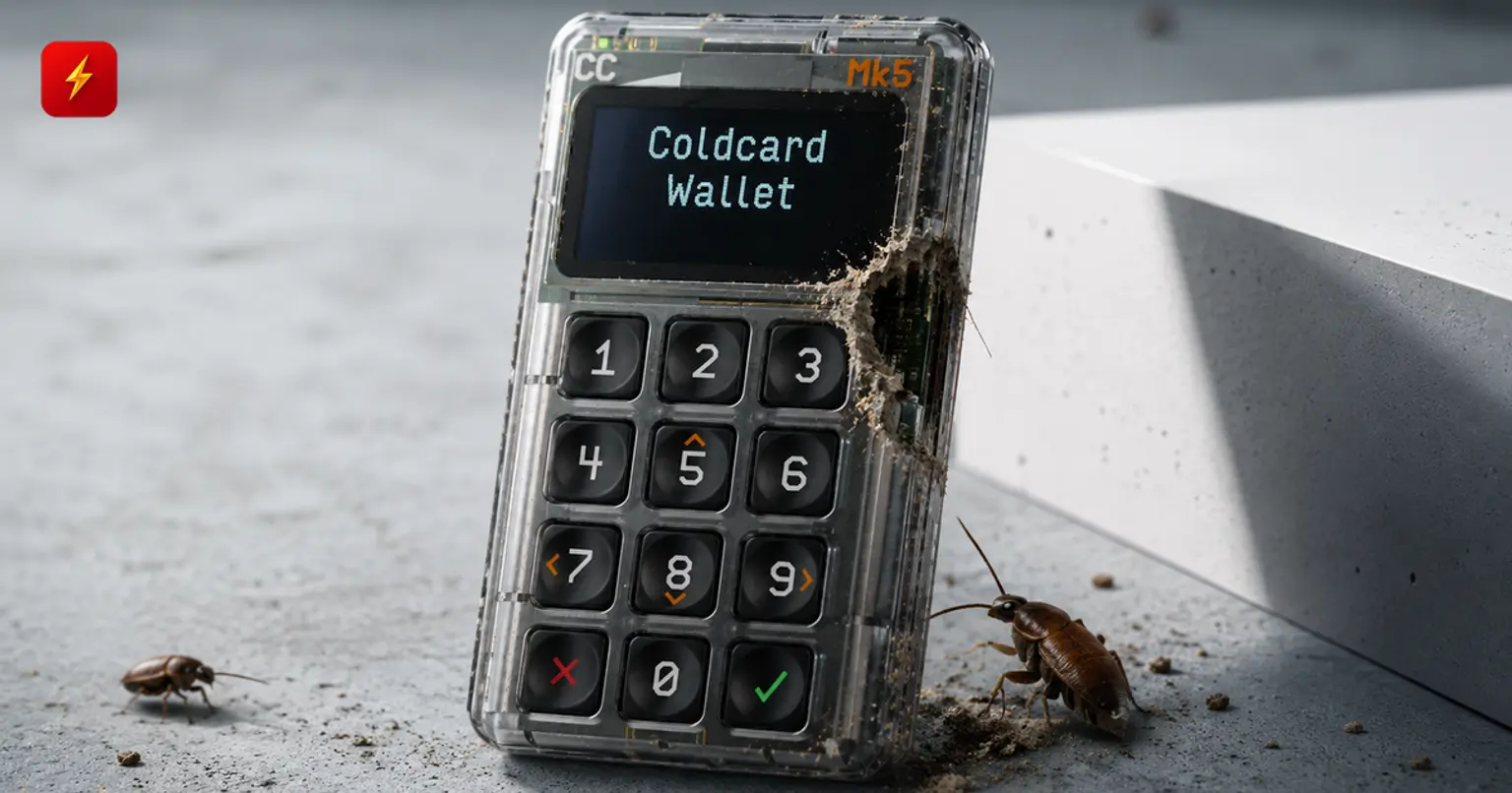
Coldcard hack: a fourth wave pushes losses toward $114 million
The Coldcard wallet exploit isn't over — it keeps growing in waves. On the morning of August 3, Galaxy Research analyst Alex Thorn flagged a fourth wave of theft, and combined losses across all waves are now approaching $114 million, according to CoinDesk.
The attack's timeline: the first wave began on July 30 and took just 41 minutes, draining roughly 1,083 BTC. The second and third waves hit over the weekend, adding roughly 1,367 BTC to the running total. The fourth wave started early Monday morning — by Thorn's estimate, it hit around 462 victim addresses across blocks 960,778-960,792, with the rate of wallet "sweeps" jumping to roughly 14 per block versus 0.3 in the pre-incident baseline.
“Every single-sig Coldcard address created after the March 2021 firmware flaw will eventually be drained.”
— Alex Thorn, Alex Thorn, Galaxy Research, post on X, August 3, 2026
The root cause traces back to a firmware commit from March 2021: seed generation for new wallets was quietly switched from the hardware random-number generator to a predictable software one, making keys partially reconstructable from data on the device itself. The issue only affects single-sig wallets — multisig setups aren't exposed. Coinkite, Coldcard's manufacturer, has already released emergency firmware and is advising owners to move funds onto freshly generated seed phrases.
We previously covered how the Coldcard attack grew to $89 million, and the situation hasn't slowed down since — it's just gone through another round. Some victims have a narrow window in the moment: the attacker is using Bitcoin's replace-by-fee feature, meaning an owner actively watching the mempool may have a few minutes to outbid the thief's fee and reclaim their own funds.
Thorn is describing the fourth wave as likely rather than fully confirmed, and the final tally is still being updated through the day. But the broader pattern is already clear: any Coldcard address generated over the past five years on the vulnerable firmware stays at risk until its funds are moved to a new key.
None of this should be read as personalized investment advice.

Comments (0)
No comments yet — be the first!
Related news

Bitcoin at a crossroads: $62,000 decides the path to $73,000 or $49,000

BitGo's CEO dared Claude to hack a $6.3 million bitcoin wallet
Trump Media denies selling bitcoin again — same words as three months ago
Most read
Silicon Valley Workers Are Wearing Noise-Cancelling Masks to Dictate AI Prompts
213 views
Elon Musk Expands Access to X Money, the Payments Service Inside X
153 views
Strategy Didn't Buy Any Bitcoin Last Week — and Now Has a Plan to Sell It
45 views
Layer-2: How Blockchains Get Faster Without Touching the Base Chain
44 views
Silicon Valley's weird AI-dictation mask trend is the tip of a $22 billion voice AI boom
32 views
Crypto Cards That Never Take Your Keys
32 views
Crypto Market Drops 4-5% in a Day: What Volume and Traders Are Saying
31 views